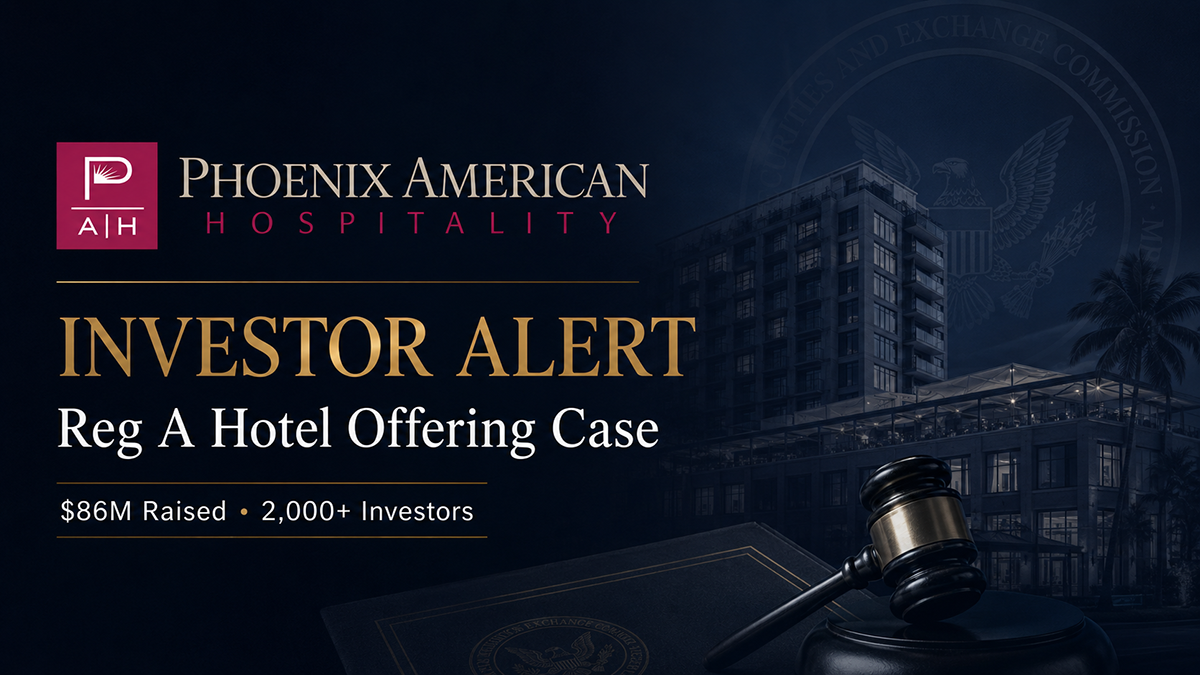
The SEC has finalized a settled enforcement action against Dallas-based Phoenix American Hospitality, LLC (PAH) and its president, William Lee “Perch” Nelson. The case centers on an alleged $86 million hotel-focused investment scheme that pulled in capital from more than 2,000 retail investors under Regulation A.
For real estate investors, the pitch was a familiar one: a tangible portfolio of commercial hospitality assets yielding predictable, double-digit income. According to federal regulators, however, the underlying reality was built on severe misrepresentations.
The SEC’s complaint was filed on June 4, 2026, in the Northern District of Texas, and final judgments were ordered on June 5, 2026. Investors should review the official regulatory findings carefully. (SEC Litigation Release: www.sec.gov/enforcement-litigation/litigation-releases/lr-26560) (Official SEC Complaint: www.sec.gov/files/litigation/complaints/2026/comp26560.pdf)
Anatomy of the Alleged Misconduct
The SEC’s investigation targeted two Reg A offerings managed by PAH: American Hospitality Properties REIT I and REIT II. Between March 2022 and July 2024, the SEC alleges that PAH and Nelson utilized fraudulent marketing emails, webinars, and website updates to mislead the public on two critical fronts:
-
The Property Portfolio Pitch: Marketing materials claimed REIT I had already purchased and owned as many as 11 hotel properties. In reality, REIT I owned only a preferred equity interest in a single hotel until January 2024. REIT II owned zero hotel assets for most of the period.
-
The 12% Distribution Pitch: Nelson told investors that funds were distributing regular annualized payouts of up to 12% sourced from mandatory REIT operating profits. In reality, neither fund was ever profitable. For example, REIT I earned just over $200,000 through late 2022 but distributed over $1.4 million to investors—using new investor capital to fund the distributions.
Without admitting or denying the allegations, both defendants consented to final judgments. The court ordered PAH to pay a $591,127 civil penalty and Nelson to pay a $118,225 civil penalty, alongside a strict five-year officer and director bar against Nelson. Effective May 20, 2026, both REIT entities cut ties and terminated their management contracts with PAH.
The Recovery Path: Holding Financial Advisors Accountable
When an issuer faces regulatory enforcement, direct recovery from the company can be complex or severely limited. However, retail investors rarely buy Reg A alternative products in a vacuum—they are typically sold through third-party stockbrokers, financial planners, and investment advisory firms.
Brokerage firms owe their clients an absolute legal duty under FINRA rules and Regulation Best Interest (Reg BI) to thoroughly vet any alternative asset before pitching it. Investors looking to recover their losses should consider these critical factors:
-
Document the Pitch: Review all emails, subscription agreements, and marketing brochures provided by your broker. Did they emphasize “safe,” “stable,” or “guaranteed” real estate returns while glossing over the fund’s lack of liquidity?
-
Evaluate Due Diligence: Determine if your advisory firm relied blindly on PAH’s glossy marketing slide decks. Brokers are legally required to verify an issuer’s claims independently—not just copy and paste their sales pitches.
-
Check Allocation Levels: Examine your overall portfolio. Private real estate Reg A funds are highly illiquid. If your advisor placed an unsuitably large percentage of your liquid net worth into these funds, they may be liable for overconcentration.
-
File a FINRA Arbitration Claim: If due diligence failures or unsuitable recommendations took place, investors can bypass slow-moving class actions and file a direct claim through FINRA arbitration to recover their lost principal.
Did You Lose Capital in Phoenix American Hospitality REITs?
Sonn Law Group is actively investigating investor losses tied to Phoenix American Hospitality, American Hospitality Properties REIT I & II, and related alternative real estate offerings. Our legal team aggressively pursues claims against brokerage firms and financial entities that fail to protect their clients from mismanaged alternative investments.
Investors who suffered losses in Phoenix American Hospitality or similar real estate-related private offerings may contact Sonn Law Group to discuss their legal options.