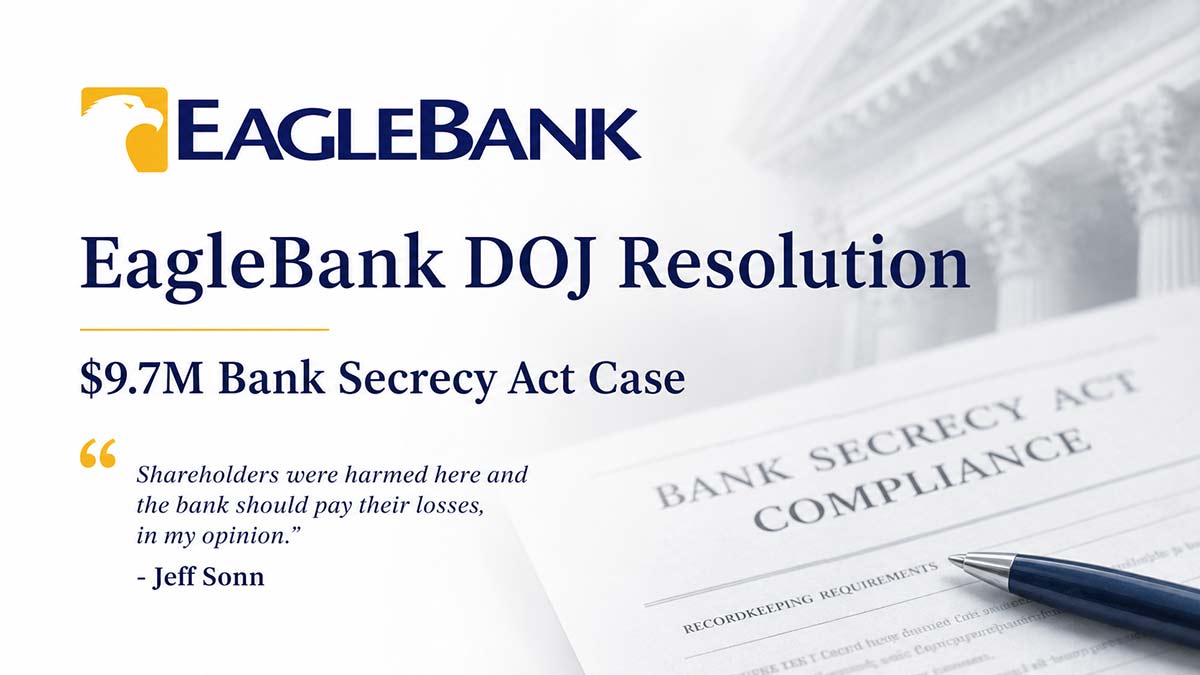
Law360 recently reported that EagleBank and its parent company, Eagle Bancorp Inc., agreed to pay more than $9.7 million under a non-prosecution agreement with the U.S. Department of Justice, adding another major regulatory development to the bank’s recent history of compliance and governance scrutiny.
According to the DOJ, EagleBank admitted that between 2010 and 2021 it willfully failed to maintain an adequate anti-money laundering and countering the financing of terrorism program under the Bank Secrecy Act. The DOJ alleged that the bank allowed two customers, a father and son, to operate a check-kiting scheme through EagleBank accounts for more than a decade, despite repeated efforts by compliance personnel to stop the activity.
The DOJ release states that senior bank executives repeatedly overrode compliance personnel who attempted to close the accounts and end the conduct. The government further alleged that the scheme caused almost $6.3 million in losses to another financial institution. Under the resolution, EagleBank agreed to pay a $9,057,821.62 fine and forfeit $736,515 in overdraft fees tied to the accounts involved in the scheme.
(Sources: Law360, U.S. Department of Justice, DOJ Non-Prosecution Agreement)
For investors, the EagleBank matter is not merely a technical Bank Secrecy Act case. It raises broader questions about internal controls, executive override, compliance culture, and whether publicly traded financial institutions are adequately disclosing risks that may affect shareholders.
“Shareholders were harmed here and the bank should pay their losses, in my opinion,” said Jeff Sonn, founder of Sonn Law Group.
The DOJ resolution also follows earlier regulatory actions involving Eagle Bancorp and its former leadership. In 2022, the SEC charged Eagle Bancorp and former CEO Ronald D. Paul with failing to properly disclose related-party loans. The SEC alleged that Eagle failed to include loans to Paul’s family trusts, totaling at times nearly $90 million, in related-party loan balances in annual reports and proxy statements. The SEC also alleged that Eagle omitted tens of millions of dollars in loans to directors and family members from those disclosures.
(Source: SEC Press Release)
That same year, the Federal Reserve fined EagleBank $9.5 million for violating insider lending rules and permanently barred Paul from the banking industry. The Fed stated that EagleBank had deficient internal controls over insider lending practices from 2015 to 2018, allowing credit to be extended to entities owned or controlled by Paul without required disclosures or board approvals.
(Source: Federal Reserve)
Taken together, these matters show why investors should pay close attention when a financial institution faces repeated enforcement actions involving internal controls, related-party transactions, suspicious activity monitoring, or executive influence over compliance decisions. Even where a bank remains operationally sound, regulatory findings can create legal, reputational, and market risks.
The EagleBank resolution also comes amid heightened attention to anti-money laundering compliance across the financial services industry. Reuters recently reported that Merrill Lynch agreed to pay $7.5 million to resolve SEC claims involving failures to file suspicious activity reports, underscoring that regulators continue to focus on whether financial institutions are properly detecting and reporting suspicious activity.
(Source: Reuters)
Investors should understand that compliance breakdowns can become securities issues when public statements, financial reports, proxy disclosures, or risk disclosures do not accurately reflect known problems. Allegations involving related-party loans, internal control weaknesses, executive conflicts, or regulatory investigations may be material to investors evaluating a company’s governance and risk profile.
Sonn Law Group continues to monitor regulatory and enforcement developments involving banks, broker-dealers, investment advisers, and public companies. Investors who suffered losses after relying on allegedly misleading statements, incomplete disclosures, or inadequate risk reporting may have legal options.