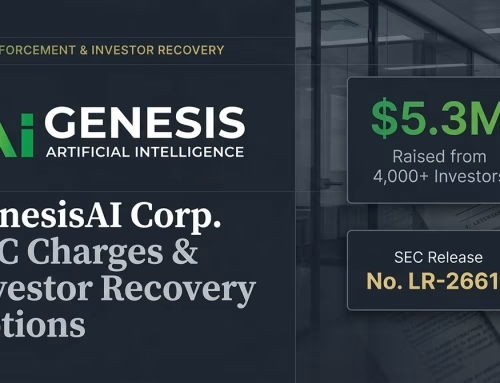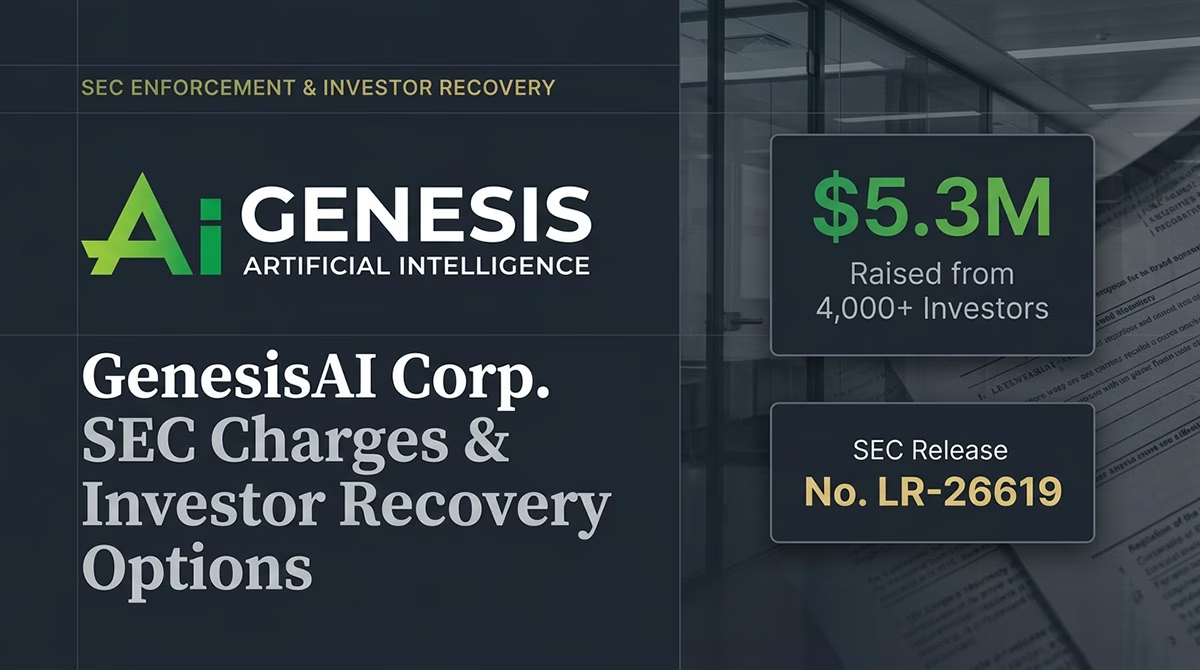
As we detailed in our recent analysis of the SEC’s enforcement action against GenesisAI Corp. and Archil Cheishvili, more than 4,000 retail investors poured $5.3 million into a hyped artificial intelligence startup that claimed a $204 million valuation despite generating virtually zero marketplace revenue. When the company shut down its software development and settled with the SEC, regulators collected just $109,184 in total disgorgement, interest, and penalties.
For investors who lost tens or hundreds of thousands of dollars in GenesisAI or similar pre-IPO and Regulation A offerings, the SEC settlement highlights a harsh reality of startup investing: by the time federal regulators step in, the issuing company’s bank accounts are almost always empty.
However, an empty corporate treasury at the startup does not mean harmed investors are out of options. Under federal securities laws and FINRA rules, the registered broker-dealers, placement agents, and wealth managers that marketed, recommended, or facilitated the offering have an independent legal duty to investigate the issuer before taking a dime of investor money. When they fail in that gatekeeper role, investors can pursue full recovery from those solvent financial firms through FINRA arbitration.
1. The Regulation A and Private Placement Loophole: How Unvetted Deals Reach Retail Investors
Historically, risky early-stage venture deals were restricted to wealthy institutions and venture capital funds that employed teams of forensic accountants to audit a founder’s books. Today, loosened securities exemptions under Regulation A (Tier 2 “Mini-IPOs”), Regulation Crowdfunding (Reg CF), and Regulation D allow startups to pitch high-risk private shares directly to everyday investors.
To make these offerings look credible and legally compliant, startups routinely hire FINRA-registered broker-dealers to act as the “broker-dealer of record,” placement agent, or managing dealer. In the 2022 GenesisAI Regulation A offering, for example, the company engaged registered broker-dealer Dalmore Group, LLC to handle administrative, compliance, and broker-dealer record functions in exchange for commissions and fees, all while the founder used the offering to cash out $51,000 of his own personal shares at a self-created $204 million valuation.
Across the private market in 2026, similar breakdowns have cost retail investors hundreds of millions of dollars:
- Unverified AI Revenue Forecasts: Startups circulate slick slide decks projecting $100 million to $250 million in future artificial intelligence revenue while their actual software remains stuck in beta testing with no paying commercial enterprise clients.
- Arbitrary Step-Up Valuations: Founders double or quadruple their company’s stated share price from one round to the next without an independent third-party valuation or audited revenue growth to support the hike.
- Marked-Up Pre-IPO Special Purpose Vehicles (SPVs): As seen in the massive federal enforcement actions against pre-IPO platform Linqto and its founder William Sarris, retail investors were sold interests in private funds purporting to hold shares of hot tech companies like Ripple, SpaceX, and Anthropic, often loaded with undisclosed markups and structural defects.
2. A Broker-Dealer Is Not a “Rubber Stamp”: FINRA Gatekeeper Rules
When a FINRA-member brokerage firm gets sued in arbitration over a failed Regulation A or Regulation D offering, its defense lawyers almost always make the same excuse: “We were knocked down by the founder’s lies just like the investors were, and we only handled the back-office paperwork.”
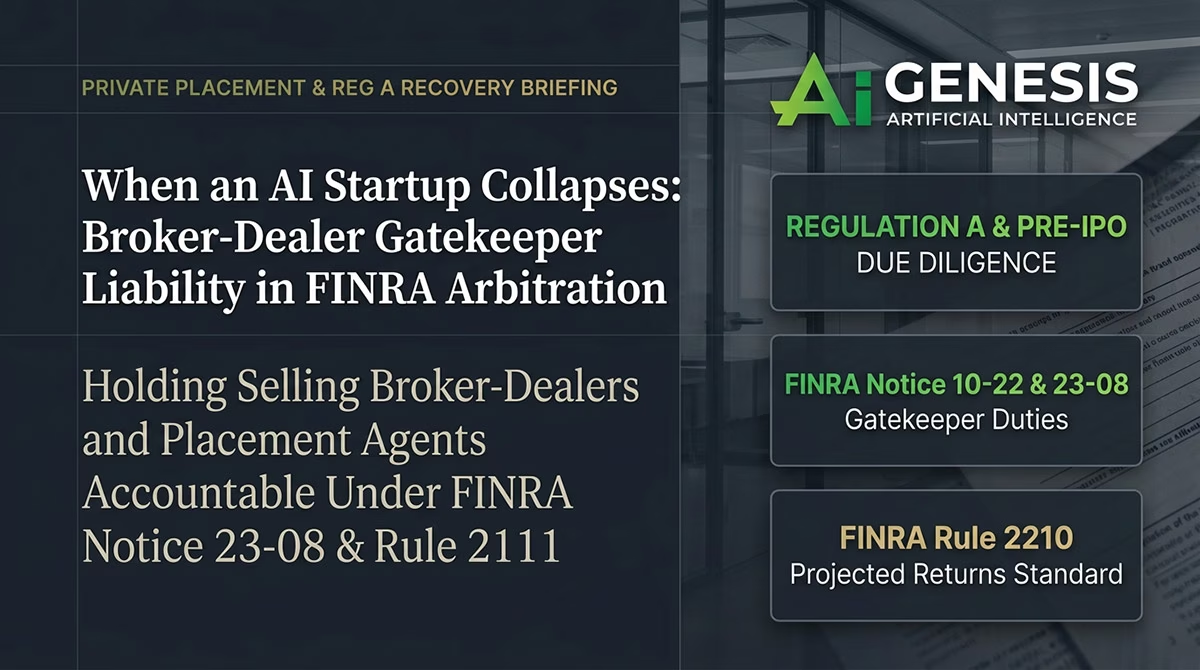
FINRA rules flatly reject that excuse. A registered broker-dealer is a licensed market gatekeeper, not a passive mailman. Under two landmark regulatory directives, FINRA Regulatory Notice 10-22 and FINRA Regulatory Notice 23-08, every brokerage firm that participates in a private or exempt offering must conduct a rigorous, independent reasonable investigation before allowing the security to be sold to customers.
Specifically, FINRA requires a participating broker-dealer to investigate:
- The Issuer’s Actual Financial Condition and Operations: A broker-dealer cannot blindly repeat a founder’s claim that an AI platform is worth $200 million or has 25 corporate partnerships. The firm must independently verify bank statements, audited financial statements, material customer contracts, and whether the technology actually works.
- Red Flags in Valuation and Insider Cash-Outs: When an early-stage company with near-zero revenue ratchets its valuation from $7.5 million to $204 million while simultaneously registering the CEO’s personal stock so he can cash out using new investor money, those are glaring red flags that require a broker-dealer to halt participation or demand hard proof.
- Compliance With FINRA Rule 2210 on Projected Returns: Under FINRA Rule 2210 (Communications with the Public), broker-dealers are strictly restricted from distributing retail sales literature that contains exaggerated, unwarranted, or baseless financial projections (such as claiming a startup with zero revenue will hit $250 million in annual sales within four years).
3. Two Paths to Recovery When a Private or Reg A Offering Fails
If you lost a significant amount of money in GenesisAI Corp., a pre-IPO SPV, or another failed Regulation A or Regulation D private placement, our attorneys evaluate two primary avenues for recovery in FINRA arbitration:
Path 1: Claims Against the Financial Advisor Who Recommended the Deal
If a licensed financial advisor, stockbroker, or registered investment advisor steered you into a private placement or Regulation A stock, that advisor had a duty under the SEC’s Regulation Best Interest (Reg BI) and FINRA Rule 2111 to ensure the investment matched your risk profile and that your portfolio was not overconcentrated in speculative, illiquid startups.
Path 2: Claims Against the Selling Broker-Dealer or Placement Agent
Even if you did not use a traditional full-service wealth manager, if your purchase was processed, underwritten, or facilitated through a FINRA-registered broker-dealer of record or placement agent, that brokerage firm owed mandatory gatekeeper duties to verify the offering under FINRA Rule 3110 (Supervision) and Regulatory Notices 10-22 and 23-08. When a registered broker-dealer lends its license and credibility to a deeply flawed offering without performing basic due diligence on the issuer’s revenue and valuation claims, the brokerage firm can be held financially liable for the resulting investor losses.
Frequently Asked Questions
Why pursue a FINRA arbitration claim instead of joining a class action against the startup?
When a small or mid-sized Regulation A startup or private placement collapses, the company itself typically has no cash and no meaningful directors-and-officers (D&O) insurance left after paying defense lawyers and SEC penalties. A FINRA arbitration claim targets the licensed, insured brokerage firms and placement agents that profited from selling the offering while failing to conduct mandatory due diligence.
Does signing an “Accredited Investor” questionnaire waive my right to bring a FINRA claim?
No. Checking a box stating that you meet the income or net-worth threshold of an accredited investor does not give a brokerage firm permission to sell you an unvetted fraud or concentrate your retirement savings in speculative private placements. Broker-dealers owe due-diligence duties under FINRA Notice 23-08 regardless of whether the buyer is accredited or non-accredited.
Can senior investors get an accelerated FINRA arbitration timeline for private placement losses?
Yes. Under FINRA Rule 12808, which took effect on March 30, 2026, any claimant who is at least 70 years old or who certifies a serious medical condition is entitled to mandatory shortened deadlines for discovery and final arbitration hearings.
Speak With a Private Placement & Securities Fraud Lawyer at Sonn Law Group
If you suffered substantial losses in GenesisAI Corp., Linqto, or another Regulation A, Regulation D, or pre-IPO private placement, do not assume your money is gone forever just because the startup shut down.
Sonn Law Group represents individual and institutional investors nationwide in FINRA arbitration and securities litigation against the brokerage firms, placement agents, and investment advisors that failed to protect their clients. We work on a contingency-fee basis, meaning you pay no legal fees unless we recover compensation for you. Contact our office today for a free, confidential evaluation of your case.