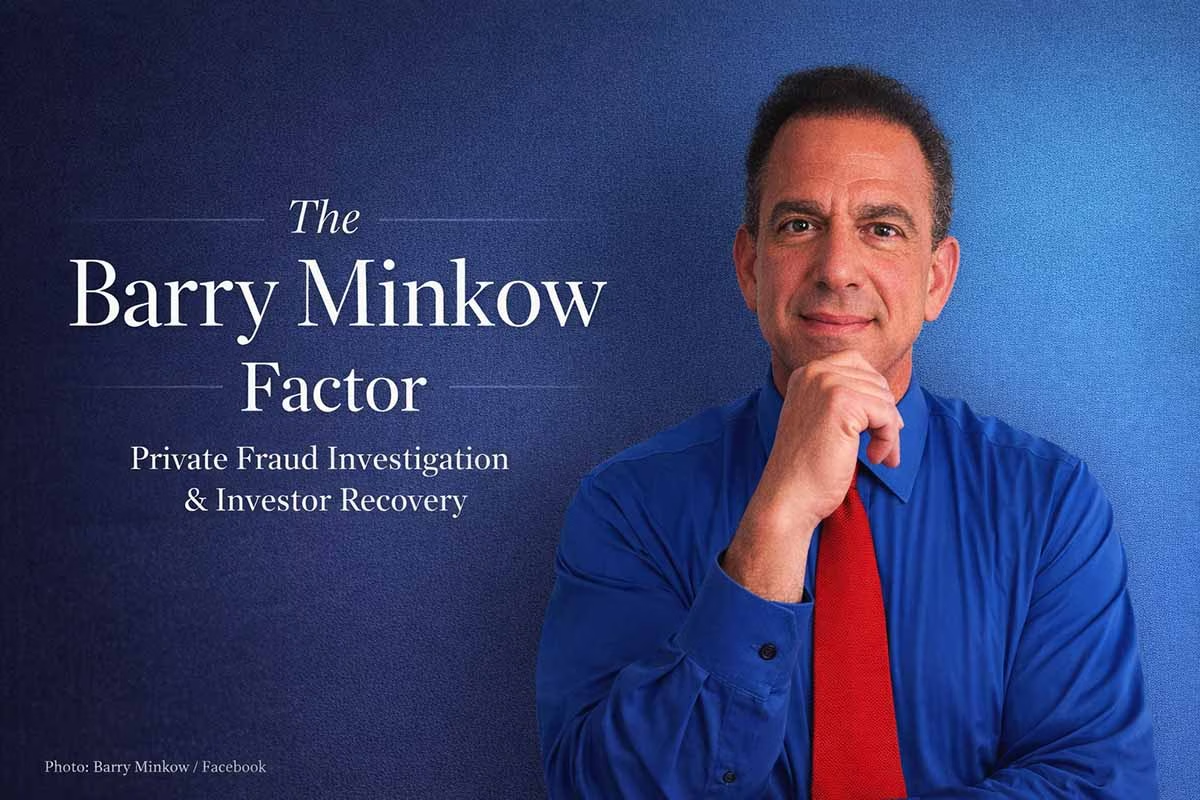
Introduction: The Investigation Behind the Investigation
When Barry Minkow published his account of a “reverse sting” involving Mohamed Coulibaly and Motion Ventures, something important happened—but not what most observers assumed.
Minkow’s involvement did not prove fraud. It illustrated something more useful: how modern investment disputes get investigated, what role private actors play, and where the actual evidence for investor recovery lives.
The publicly reported allegations are substantial: three former NFL players lost over $1 million collectively through purportedly automated Shopify stores. Dashboard activity that allegedly showed hundreds of orders was questioned by independent analysis. A disputed $215 million acquisition was presented to investors but never verified. An escrow document referencing JPMorgan Chase was reportedly disavowed by the bank. (Barron’s via AOL)
But allegations, no matter how detailed or corroborated by journalists, do not automatically become recoverable claims. That conversion happens through law—not publicity.
Part I: Who Barry Minkow Is—And What That Means
Barry Minkow founded ZZZZ Best, a carpet-cleaning company that became a historic fraud involving over $100 million in investor losses. He served federal prison time, then reinvented himself as a fraud investigator, only to face later criminal convictions including a 2014 federal guilty plea involving fraud-related conduct. (Department of Justice)
This history matters for one reason: it defines how to evaluate his work.
Minkow is neither a regulator nor a court. He is not impartial. But he possesses genuine expertise in how frauds are constructed, maintained, and disguised—knowledge earned through committing one himself.
The responsible approach is not automatic endorsement or dismissal. It is corroboration.
Part II: What a “Reverse Sting” Actually Establishes
According to Minkow’s published account, he posed as a prospective investor with approximately $2 million available and documented how the opportunity was presented on February 18, 2026. (LinkedIn) He reportedly described claims involving passive ownership, six-month holds, principal protection, and potential 60-90 day returns through pooled capital.
A controlled interaction can preserve evidence of solicitation language, promised returns, stated revenue sources, and counterparty identity.
But it has limits.
A reverse sting is not a government operation. It does not automatically establish that a crime occurred. Its value depends on:
- Whether the call was lawfully recorded
- Whether terms offered matched those given to actual investors
- Whether claims can be matched against contracts and bank records
- Whether the recorded statements are representative or outliers
For investors, the key insight is simple: A carefully documented solicitation is powerful evidence, but it must be tested against the underlying transaction records—not treated as proof by itself.
Part III: The Actual Path to Investor Recovery
Here is what most investors miss: public exposure and legal recovery are different processes.
A journalist may identify a pattern. An investigator may collect evidence. A regulator may investigate. But only an attorney can convert those findings into a recoverable claim.
That process requires determining:
- Which legal theories apply (fraud, breach of contract, securities violations, negligent misrepresentation, claims against facilitators or brokers)
- Who may be legally responsible
- Whether arbitration is required
- Whether a client has standing
- Whether assets or insurance remain available
- Whether the claim is timely
For Motion Ventures investors, the critical questions are:
What was promised? Written or oral? To whom?
What contradicts that promise? Shopify records? Payment processor data? Bank deposits?
Was an intermediary involved? Did a broker, advisor, or platform facilitate the investment? Did they conduct due diligence?
Where did the money go? Can investor funds be traced to specific accounts?
What deadline applies? Arbitration provisions typically allow 6 years from discovery of harm, but that clock is running.
Part IV: The Evidence That Actually Matters
Minkow’s reverse sting may document the sales pitch. But investor recovery depends on evidence that can be independently verified:
Store-level data: Shopify order logs, administrative access records, payment processor data, web-traffic analytics, shipping confirmations, refunds and chargebacks, advertising accounts, and bank deposits corresponding to alleged sales.
A dashboard can show activity. It does not prove that real customers placed orders, paid money, received products, or generated profit.
Entity-level records: Who controlled the entities? What bank accounts received funds? Were there intercompany transfers? Do related companies share personnel or addresses?
Acquisition documentation: Did a term sheet exist? A binding agreement? An escrow instruction? A wire confirmation? These are not interchangeable documents.
Third-party involvement: Did a broker recommend the investment? Did an advisor conduct due diligence? Did a payment processor raise flags? Each participant may carry separate liability.
Part V: What Investors Should Actually Do
Do not wait for a government announcement to protect your claim.
Instead:
- Preserve everything: Contracts, communications, wire confirmations, dashboard screenshots, payment records. Do not delete or overwrite original files.
- Calculate your net loss: Original wire transfers, credit-card payments, service fees, additional store purchases, reinvested distributions, unpaid principal and profits, any amounts later received.
- Identify the entities: Every company name on contracts, the entity that received funds, the entity that made representations, related companies, officers and managers.
- Determine deadlines: Arbitration claims and litigation have filing deadlines. Waiting for a regulatory action may cost you your claim.
- Evaluate third-party involvement: Was an advisor, broker, or promoter involved? Did they conduct due diligence? Claims against facilitators may be faster or more recoverable than claims against the primary promoter.
- Obtain legal assessment promptly: Attorney-client privilege protects confidential communications. A preliminary review by experienced counsel can map recovery pathways without creating public record.
Part VI: Why Sonn Law Group’s Role Is Different from Minkow’s
Barry Minkow’s contribution is investigative: collecting evidence, documenting patterns, bringing information to light.
Sonn Law Group’s role is legal: converting that investigative work into enforceable claims, identifying responsible parties, calculating damages, managing deadlines, and executing recovery strategy.
Those are different functions requiring different expertise.
An investigator may identify that store dashboards appear inconsistent with traffic data. An attorney determines whether that inconsistency constitutes actionable misrepresentation, against whom, under what legal theory, and what evidence a court or arbitrator will require.
An investigator may show that a transaction document exists. An attorney determines whether it is binding, enforceable, authentic, and whether it creates liability for the signatory and their employer.
Conclusion: From Allegation to Recovery
The Mohamed Coulibaly and Motion Ventures matter has attracted legitimate attention. The reported allegations involving athlete losses, dashboard irregularities, unverified acquisitions, and disputed escrow documents raise serious questions.
But questions do not return money.
Recovery requires discipline: understanding what was promised, what contradicts that promise, who bears legal responsibility, and what deadline applies.
Sonn Law Group is investigating potential claims on behalf of investors who may have suffered losses through Motion Ventures, Motion Apparelz, The Vent Motion, or related Shopify investment opportunities.
The time to act is now—not after waiting for a regulatory announcement.
Investors should preserve records, calculate losses, and obtain a confidential legal assessment promptly. Arbitration provisions, statutes of limitation, and procedural deadlines do not wait for public conclusions.