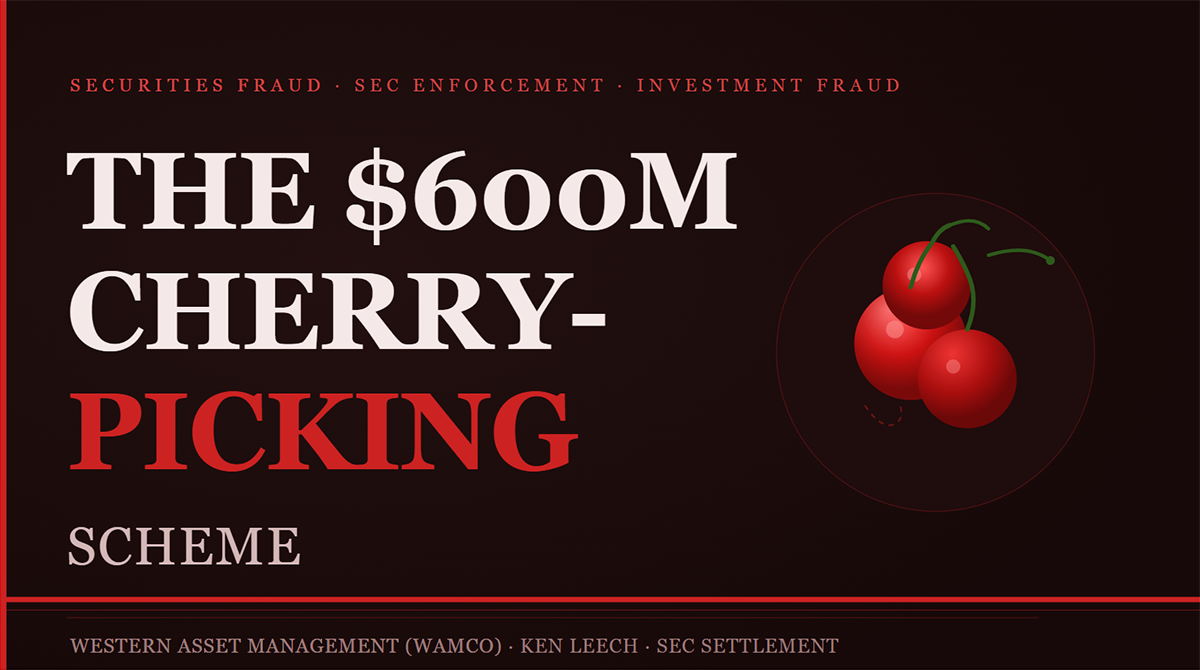
Western Asset Management (WAMCO) and parent Franklin Resources have agreed to pay a massive $100 million SEC penalty, placing renewed attention on allegations that former Chief Investment Officer Ken Leech orchestrated a years-long trade-allocation scheme that regulators claim improperly shifted hundreds of millions of dollars among client accounts. Here is what the settlement means for investors.
The massive $100 million civil penalty agreed to by Western Asset Management Company (WAMCO) shifts the spotlight directly back onto former Chief Investment Officer Ken Leech.
While a corporate settlement often signals the end of a regulatory chapter, this massive fine does something entirely different: it opens a window into one of the largest alleged trade-allocation fraud cases in the investment management industry in recent years. According to Reuters, the settlement resolves SEC claims against the firm while the allegations involving Ken Leech continue to draw significant scrutiny. (www.reuters.com/legal/government/franklin-resources-wamco-pay-100-million-sec-fine-over-alleged-cherry-picking-2026-06-05/)
For affected institutional investors, the settlement is not necessarily a resolution—it is a detailed roadmap showing how internal controls allegedly failed to protect client assets.
Anatomy of the Alleged Scheme: How the Trade Allocation Process Worked
To understand why federal regulators and prosecutors are treating this matter so seriously, it helps to examine the underlying allegations.
According to the Securities and Exchange Commission, Ken Leech allegedly manipulated the trade-allocation process over a period of years, using his position within the firm to favor certain accounts at the expense of others. (www.sec.gov/newsroom/press-releases/2024-187)
The alleged misconduct centered on a practice commonly referred to as “cherry-picking,” in which trade allocations are delayed until after market movements become known.
According to SEC filings, Leech allegedly began trading Treasury derivative positions as early as 5:00 a.m. Pacific Time but often delayed final allocation decisions until after noon, when settlement pricing information became available. (Source: www.sec.gov/enforcement-litigation/litigation-releases/lr-26183)
Regulators allege that this delay allowed profitable trades to be directed into favored portfolios while less favorable trades were allocated elsewhere.
Under the SEC’s allegations:
- Profitable trades were disproportionately allocated to preferred accounts.
- Losing trades were disproportionately assigned to other client portfolios.
- The resulting impact allegedly produced approximately $600 million in improperly allocated gains and losses across affected accounts.
Federal prosecutors later echoed many of these allegations in criminal charges filed against Leech, describing what they characterized as a years-long scheme involving Treasury derivative trading and post-trade allocation decisions. (www.justice.gov/usao-sdny/pr/former-chief-investment-officer-global-bond-investment-firm-charged-over-600-million)
The Two-Front Legal Battle: Corporate Settlement Versus Criminal Liability
Investors should understand that the firm’s settlement and the criminal proceedings against Ken Leech are separate matters.
On the civil side, the SEC alleged that Western Asset Management failed to establish and enforce adequate supervisory controls that could have detected or prevented the alleged conduct. The settlement focuses primarily on the firm’s compliance systems, oversight procedures, and supervisory responsibilities. (Source: https://www.reuters.com/legal/government/franklin-resources-wamco-pay-100-million-sec-fine-over-alleged-cherry-picking-2026-06-05/)
On the criminal side, the Department of Justice continues to pursue charges against Leech personally. Criminal proceedings carry substantially different consequences than civil enforcement actions and may result in penalties that extend beyond financial sanctions. (www.justice.gov/usao-sdny/pr/former-chief-investment-officer-global-bond-investment-firm-charged-over-600-million)
The existence of a corporate settlement does not resolve or eliminate the criminal allegations against individual actors.
What This Means for Investors
For pension plans, institutional investors, retirement accounts, and private wealth clients whose assets were managed within affected Western Asset Management strategies, the SEC settlement represents an important development.
Regulatory settlements frequently serve as a catalyst for further review by investors seeking to determine whether their portfolios suffered harm beyond ordinary market losses. Regulatory penalties often address violations of securities laws, but they do not necessarily compensate every investor for losses allegedly caused by the underlying conduct.
As additional information becomes available through regulatory proceedings, court filings, and related litigation, investors may gain a clearer understanding of the scope of the alleged allocation practices and their potential impact on portfolio performance.
Contact Sonn Law Group
Sonn Law Group is investigating claims involving investment adviser misconduct, trade allocation irregularities, securities fraud, and other investment-related losses.
Investors who maintained assets in Western Asset Management strategies and have questions regarding potential losses, account recommendations, or recovery options may wish to seek an independent legal evaluation of their circumstances.