Many investors who lost money with a broker believe they don’t have enough proof to bring a claim. Others believe a large loss is proof enough on its own.
Neither is quite right. In FINRA arbitration, the evidence that matters depends on what went wrong. Proving that a broker recommended an unsuitable investment takes different records than proving the broker traded without permission. And some of the most important evidence is in the brokerage firm’s files, not yours.
In our guide to what your FINRA claim is actually worth, we explained that a loss only counts toward a claim if it can be tied to specific misconduct. This article covers how that connection is proven.
Start with the misconduct, not the paperwork
A stack of statements shows that money was lost. It doesn’t show why. Strong claims begin with a clear theory of what the broker or firm did wrong, then collect the records that support it.
Here’s how evidence typically lines up with the most common claims:
| Type of misconduct | What it means | Evidence that usually matters |
|---|---|---|
| Unsuitable recommendation | The investment didn’t fit your age, goals, finances or risk tolerance | New account forms, risk profile, stated objectives, income and net worth at the time, the recommendation itself |
| Overconcentration | Too much of your portfolio was in one investment, product type or sector | Statements showing allocation over time, especially the months before the losses |
| Excessive trading (churning) | The account was traded heavily to generate commissions | Trade confirmations, commission and fee totals, turnover and cost-to-equity calculations |
| Unauthorized trading | Trades were made without your approval in a non-discretionary account | Trade dates compared with your phone records, emails and texts; account authorization forms |
| Misrepresentation or omission | You were told something false or not told about key risks | Emails, texts, marketing materials, offering documents, your notes from meetings |
| Failure to supervise | The firm didn’t catch or stop a broker’s misconduct | Firm records you won’t have yet, such as exception reports and supervisory reviews (see below) |
Most cases involve more than one of these. An unsuitable recommendation often goes along with overconcentration, and churning often goes along with failure to supervise.
Evidence you likely already have
Before calling a lawyer, gather what’s within reach:
- Account statements covering the period before, during and after the losses
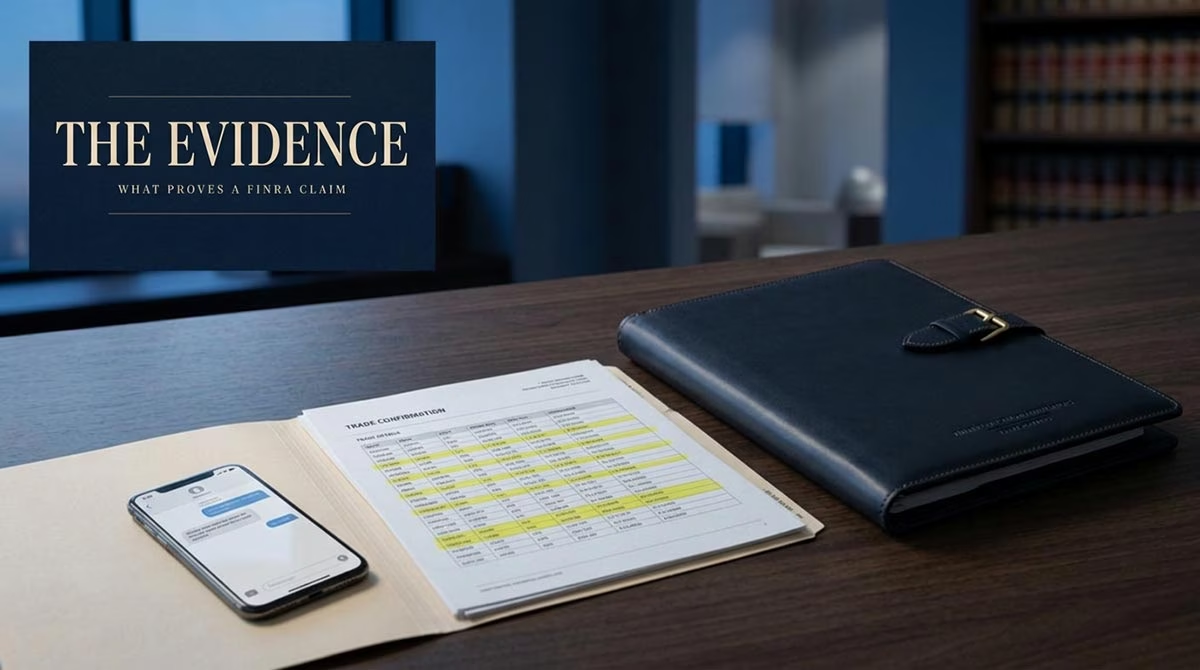
- Trade confirmations for the transactions at issue
- Account opening documents and any updated profile forms
- Emails and text messages with the broker or anyone at the firm
- Marketing materials, brochures or offering documents for the investment
- Your own notes, calendar entries or recollections of meetings and calls, with dates
One point investors often miss: look closely at your new account form. Firms record your investment objectives, risk tolerance and net worth there. Sometimes the form says you were an aggressive investor with years of experience when you weren’t. That gap between the paperwork and the truth can become key evidence.
Preserve everything. Don’t delete texts, clear your inbox or throw out old mail. Save texts by taking screenshots that show the dates, or export the threads.
Evidence the firm has that you don’t
Many investors hold back because their own files feel thin. FINRA’s discovery process is designed with that in mind.
In customer arbitrations, FINRA’s Discovery Guide sets out documents that are presumed to be discoverable. Brokerage firms are generally required to produce a set list of records, including:
- Your account records and the firm’s notes about your account
- Correspondence about your account, including internal communications
- Records of investment strategies used or recommended for you
- Exception reports, supervisory reviews and concentration reports about activity in your account
- The firm’s compliance manuals and procedures related to the conduct at issue
Those supervisory records can be some of the most revealing evidence in a case. They can show that the firm’s own systems flagged a problem and that nobody acted on it.
When a claim centers on a specific product, such as a private placement or unit investment trust, the case may reach further. Parties often seek documents about how the firm vetted the product, trained its brokers and marketed it.
Evidence the firm will ask you for
Discovery goes both ways, and it’s better to know that going in. FINRA’s list for customers generally includes portions of tax returns, financial statements, statements from other investment accounts and documents you received about the investments at issue.
Firms use these records to argue that you were a more experienced or aggressive investor than you claim, or that you knew the risks. That’s why consistency matters. Your account of what happened should match what your documents show, and a lawyer should review potential weak spots before the claim is filed, not after.
Public records worth checking
- FINRA BrokerCheck shows a broker’s employment history, customer complaints, regulatory actions and terminations. A pattern of similar complaints may support your claim, and it may also point to a failure to supervise.
- FINRA arbitration awards are public and can show whether a firm or product has faced similar claims.
- SEC and state regulatory actions can reveal broader problems with a firm or an investment.
Witnesses and testimony
Documents carry most FINRA cases, but testimony still matters. At the hearing, you’ll typically explain what you were told and what you understood. Family members who attended meetings, other advisers and damages experts may also testify.
FINRA arbitration relies on document exchange much more than court litigation does. Depositions are strongly discouraged under FINRA’s rules and are allowed only in limited circumstances. That makes the written record even more important.
Why evidence and claim size go together
Building a strong record takes real work. That means reviewing years of statements, getting firm documents through discovery, calculating losses and often hiring a damages expert. The effort is similar whether the claim is worth $60,000 or $600,000.
For smaller claims decided on written submissions alone, FINRA’s standard document lists don’t automatically apply. That’s one reason Sonn Law Group generally prioritizes matters involving at least $100,000 in documented, potentially recoverable losses. A claim of that size is more likely to justify the investigation it needs. This is a firm intake guideline, not a FINRA rule, and each matter is reviewed on its own facts.
Your pre-consultation checklist
Before you contact a securities attorney, try to answer:
- What do you believe went wrong? Pick the closest match from the table above.
- When did it happen? Give approximate dates for the recommendation, trades or losses.
- What do you have? Statements, confirmations, account forms, emails and texts.
- What were you told? Write down key conversations while you still remember them.
- Who was involved? The broker’s name, the firm and whether the firm is still in business.
- What’s the net out-of-pocket loss? Use the worksheet in our claim value guide.
You don’t need every document to start. Time limits may apply to your claim, so don’t hold off waiting for a perfect file.
Request a case review
If you believe your investment losses resulted from broker or adviser misconduct and your documented losses meet our guideline, Sonn Law Group can review your records and discuss your options. Investors 70 or older may also qualify for FINRA’s accelerated arbitration rules. Each matter is evaluated individually. No particular result or recovery is guaranteed.