Over the past several weeks, federal prosecutors and securities regulators have announced a wave of indictments, guilty pleas, and multi-decade prison sentences against financial professionals who used fake promissory notes and unapproved side deals to steal tens of millions of dollars from retail investors.
Whenever a licensed broker or financial advisor is arrested for running a Ponzi scheme, the brokerage firm that employed them almost always issues the exact same press statement: “The advisor sold those investments on their own, outside of our firm, and we never approved them.”
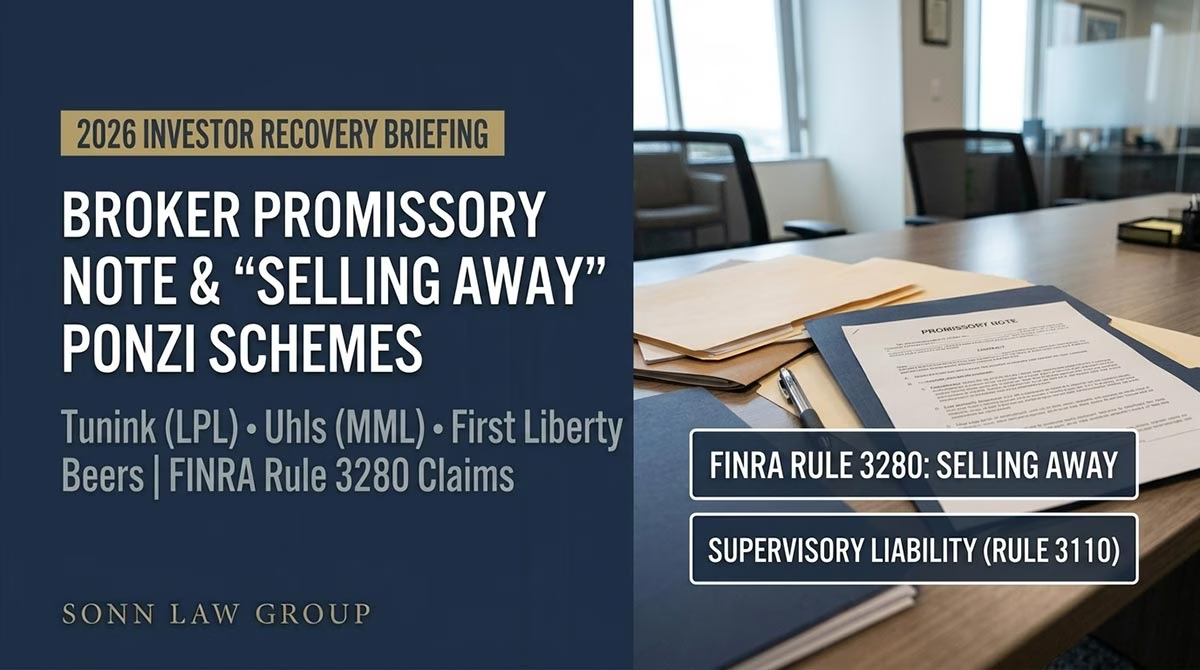
Many defrauded retirees read that statement and assume they have no legal recourse against the brokerage firm. In reality, that practice has a specific name under federal securities law: selling away. Under FINRA Rule 3280 and FINRA Rule 3110, a brokerage firm has a strict legal duty to monitor its advisors and prevent them from operating unapproved investment schemes under the firm’s roof. When a firm misses obvious red flags, harmed investors can pursue full financial recovery directly from the brokerage firm through FINRA arbitration.
At Sonn Law Group, we are tracking four major promissory note and selling-away Ponzi cases making headlines in late 2026 that demonstrate exactly how these schemes work and how victims are recovering their life savings.
1. Former LPL Financial Broker William Bernard Tunink: $11 Million Iowa Ponzi Indictment
In Des Moines, Iowa, a federal grand jury indicted 73-year-old former LPL Financial and Avantax Investor Services broker William Bernard Tunink (CRD #1413669) on 10 counts of federal wire fraud, with a criminal trial scheduled for November 30, 2026.
According to federal prosecutors, between at least February 2022 and May 2025 (matching his tenure with LPL Financial in West Des Moines from October 2021 to September 2025), Tunink raised more than $11 million from over 50 investors, resulting in more than $2 million in net unrecovered losses:
- The “Tax-Free” Promissory Note Pitch: Targeting longtime clients and community members who viewed him as a close friend, Tunink solicited checks and wire transfers under the guise of buying “investment units,” promissory notes, or partner buyout stakes in outside companies, promising high, supposedly tax-free returns.
- Classic Ponzi Diversions: Instead of investing the money as promised, prosecutors allege Tunink used incoming investor checks to pay off his own personal debts and make Ponzi-style interest payments to earlier investors.
- Proof That Brokerage Firms Pay Out: While FINRA permanently barred Tunink in June 2026 for refusing to cooperate with its investigation, Tunink’s public FINRA BrokerCheck report reveals that 21 customer complaints involving his conduct have already settled for nearly $2.5 million over the past 15 months.
2. Former MML Investors Services Associated Person Trevor Uhls: $3.8 Million Missouri Real Estate Note Scheme
In federal court in Kansas City, Missouri, 29-year-old Trevor Uhls (CRD #7747466) pleaded guilty to wire fraud and money laundering after admitting that he defrauded at least 60 investors out of more than $3.8 million.
Uhls was associated with MML Investors Services, LLC (the broker-dealer arm of insurance giant MassMutual) from May 2023 until January 2026, when the firm terminated him following a complaint over unauthorized promissory note sales. FINRA permanently barred Uhls in May 2026 after he refused to turn over his bank and phone records under FINRA Rule 8210.
Federal court filings show how Uhls used his affiliation with a household-name financial institution to build trust:
- 30-to-90-Day “Crowdfunded” Real Estate Notes: Starting in September 2024, Uhls pitched investors on short-term pooled loans supposedly backing local construction companies and storage unit developments, promising guaranteed returns of 8.5% to 15% in just 30 to 90 days.
- Using Firm Systems to Look Legitimate: Victim attorneys noted that Uhls ran the scheme out of an MML branch office and used the firm’s email system and DocuSign electronic signature accounts to send out fabricated promissory notes. In one instance documented by IRS investigators, after an investor wired $15,000 for a supposed storage-unit loan, Uhls immediately took that money to a local jeweler and bought more than $20,000 worth of Rolex watches and bracelets.
Even though MML Investors Services publicly stated that it never approved Uhls’ promissory notes, a brokerage firm cannot ignore what happens inside its own branch offices and email servers.
3. First Liberty Building & Loan ($140M Ponzi) and Former Bankers Life Broker Timothy Darnell
In Atlanta, Georgia, federal judge sentences and FINRA arbitration payouts are colliding in the collapse of First Liberty Building & Loan, LLC, a $140 million Ponzi scheme that defrauded more than 300 investors out of over $76 million.
On October 26, 2026, First Liberty founder Edwin Brant Frost IV was sentenced to 15 years in federal prison and ordered to pay more than $76 million in restitution after admitting that he lured conservative retirees into high-interest “bridge loan” promissory notes promising 8% to 18% returns, using new investor money to cover widespread loan defaults and $17 million in personal and insider spending.
Because Frost’s company is in receivership and cannot make victims whole, investors who were steered into First Liberty by licensed financial advisors have turned to FINRA arbitration with major success:
- Former Bankers Life Broker Timothy Nathaniel Darnell (CRD #6666469): Darnell was registered with Bankers Life Securities, Inc. and Bankers Life Advisory Services in Atlanta from 2016 until September 2025, when the firm fired him for failing to disclose outside business activities, engaging in unapproved private securities transactions, and using off-channel communications to pitch First Liberty notes.
- Multi-Million-Dollar Settlements and Pending Claims: While Bankers Life contended it did not know Darnell was pitching First Liberty bridge loans to more than 45 customers, the firm has already agreed to pay $6.7 million to compensate affected investors, and five separate FINRA arbitration claims (including $1,000,000 and $400,000 dockets) remain active on Darnell’s BrokerCheck record.
4. Former LifeMark Securities Broker Paul Beers: $9.7 Million KJM Financial Ponzi Guilty Plea
Rounding out the late-2026 enforcement wave, 67-year-old New Jersey financial planner and former LifeMark Securities Corp. registered representative Paul Beers (CRD #1928992) pleaded guilty in Trenton federal court on October 29, 2026 to wire fraud charges stemming from a decade-long Ponzi scheme run through his Bedminster firm, KJM Financial.
According to the Department of Justice criminal information, between January 2015 and November 2025, Beers collected more than $11 million from at least 65 clients, resulting in over $9.7 million in net investor losses. Prosecutors revealed that Beers:
- Used his college-planning and financial-advisory business to convince families to liquidate legitimate brokerage accounts and hand the cash over to him for purported “guaranteed income contracts” and investment accounts.
- Diverted the funds into his own bank accounts to cover personal expenses, business loans, and Ponzi payouts to earlier clients.
- Created fake quarterly performance statements on KJM letterhead listing fictitious account numbers at legitimate financial institutions to keep victims from discovering their money was gone.
5. How FINRA Rules 3280 and 3110 Force Brokerage Firms to Pay for “Selling Away”
If you were defrauded by a financial advisor in any of these schemes, or in similar promissory note frauds like the $62.5 million Norada Capital Management Ponzi scheme, do not wait years hoping that a federal criminal restitution order will return your money. Criminal defendants almost always spend the stolen cash long before they are indicted.
Instead, the fastest and most reliable path to recovery is a FINRA arbitration claim against the brokerage firm that was supposed to be watching the advisor. Here is why brokerage firms lose or settle these cases:
- Strict Supervision Over Private Securities Transactions (FINRA Rule 3280): Brokers are flatly prohibited from participating in any private securities transaction outside their firm without giving prior written notice and receiving written approval.
- Mandatory Branch and Email Audits (FINRA Rule 3110): Brokerage firms are required to run automated keyword surveillance on advisor emails, inspect branch offices, monitor outside business activities (FINRA Rule 3270), and investigate unexplained wire transfers or liquidations from customer accounts.
- Apparent Authority and Investor Trust: When an advisor meets you in a licensed branch office, hands you a business card bearing a national brokerage firm’s logo, or sends you DocuSign contracts from a corporate email address, the brokerage firm cannot wash its hands of the fraud when the investment turns out to be fake.
Frequently Asked Questions
Can I still sue the brokerage firm if I wrote my investment check to the advisor’s outside LLC instead of the brokerage firm?
Yes. In almost every selling-away Ponzi scheme (such as Trevor Uhls LLC, KJM Financial, or First Liberty Building & Loan), the rogue advisor instructs the client to wire money or write a check to an outside entity so the brokerage firm’s clearing house won’t automatically block the trade. FINRA arbitration panels routinely hold brokerage firms liable for failing to supervise advisors who direct clients to send money to outside LLCs.
Does a criminal guilty plea or prison sentence help my FINRA arbitration case?
Absolutely. When a former broker or associated person like Trevor Uhls or Paul Beers pleads guilty to federal wire fraud, the underlying fraud is no longer in dispute. Your FINRA arbitration case can focus squarely on the brokerage firm’s supervisory failures and the exact calculation of your out-of-pocket damages.
Can senior victims of a Ponzi scheme get a faster FINRA arbitration hearing?
Yes. Under FINRA Rule 12808, which became mandatory on March 30, 2026, investors who are 70 or older or who have a serious medical condition qualify for accelerated arbitration timelines, ensuring their case moves to a final resolution as quickly as possible.
Speak With a Ponzi Scheme & Selling Away Attorney at Sonn Law Group
If you lost money in a promissory note scheme, private loan, or unapproved outside investment pitched by William Bernard Tunink (LPL Financial), Trevor Uhls (MML Investors Services), Timothy Nathaniel Darnell (Bankers Life / First Liberty Building & Loan), Paul Beers (LifeMark Securities / KJM Financial), or another licensed financial advisor, our legal team can help you fight for a full recovery.
Sonn Law Group represents defrauded investors nationwide in FINRA arbitration and securities litigation. We handle all cases on a contingency-fee basis, meaning you pay no legal fees or expenses unless we recover money for you. Contact our office today for a free, confidential consultation.