

Recent developments have prompted investors to question the identity and significance of Blue Owl Capital, as well as the implications of its current situation for investment portfolios.
A comprehensive understanding of Blue Owl Capital’s scale, structure, and strategy is essential for contextualizing recent market volatility. The firm occupies a central position within the contemporary financial sector.
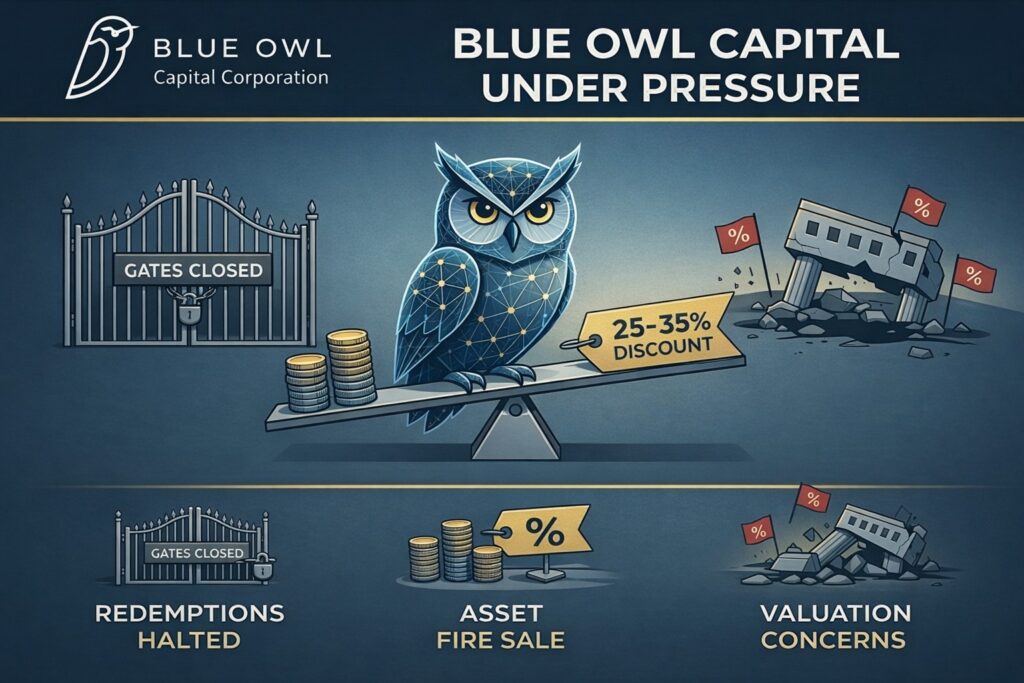
The Emergence of a Leading Private Credit Institution
Blue Owl Capital (NYSE: OWL) is a publicly traded alternative asset manager established in 2021 following the merger of Owl Rock Capital and Dyal Capital. Since its formation, the firm has experienced rapid growth. According to Reuters, Blue Owl currently manages hundreds of billions of dollars in assets across private credit, GP strategic capital (GP stakes), and real estate strategies.
This scale positions Blue Owl among the largest private credit managers in the United States. Following the 2008 regulatory changes that limited mid-market lending by traditional banks, Blue Owl addressed this gap. The firm has marketed its offerings as providing higher yields than traditional bonds and lower perceived volatility than equities.
The BDC Engine: How Retail Capital is Deployed
Blue Owl primarily utilizes Business Development Companies (BDCs) to facilitate investment. These vehicles enable both institutional and retail investors to access diversified portfolios of private loans. The platform includes the publicly traded Blue Owl Capital Corporation (OBDC) and several non-traded alternatives.
Although BDCs are effective in distributing income, they are subject to structural constraints that have been identified as potential challenges for investors by Sonn Law Group:
- Internal Valuations: Net Asset Value (NAV) is often determined by the firm’s own internal models rather than open-market trading.
- Limited Liquidity: Unlike stocks, BDCs often have strict redemption caps or “gating” provisions.
- Floating Rate Exposure: While these loans can benefit from rising rates, they also put borrowers under immense pressure to keep up with payments.
The “Permanent Capital” Paradox
A distinguishing feature of Blue Owl’s strategy is its focus on permanent capital vehicles. From a manager’s perspective, permanent capital is the “Holy Grail”—it provides predictable, recurring fee streams because the money is difficult for investors to withdraw.
For the investor, however, this creates a potential “liquidity trap.” When market conditions tighten and redemption demand increases, the very “stability” that Blue Owl touts as a corporate benefit can become a barrier for investors trying to access their own cash.
Why Blue Owl is the “Industry Proxy”
Because of its size, Blue Owl is viewed as a bellwether for the entire $2 trillion private credit industry. When Blue Owl adjusts its liquidity expectations or terminates a merger due to market pressure, it sends a signal that the broader sector may be overextended.
As Jeffrey Sonn and the team at Sonn Law Group have observed throughout decades of market cycles, rapid growth in a low-rate environment often masks structural risks. Blue Owl represents the modern institutional model of private credit—a model that is currently undergoing its first true “stress test” in a high-rate, AI-disrupted economy.
The Sonn Law Perspective: Was the Risk Fully Disclosed?
The central question for investors is not whether Blue Owl is a large or successful firm. The question is whether the structural risks—the gates, the valuation models, and the permanent capital locks—were fully and fairly explained by the brokers and advisors who recommended these products.
If you were sold a Blue Owl BDC as a safe, “bond-like” substitute for your retirement savings, you may not have been given the full picture of the liquidity risks now coming to light.
CONTACT US FOR A FREE CONSULTATION
Se Habla Español
Contact our office today to discuss your case. You can reach us by phone at 844-689-5754 or via e-mail. To send us an e-mail, simply complete and submit the online form below.