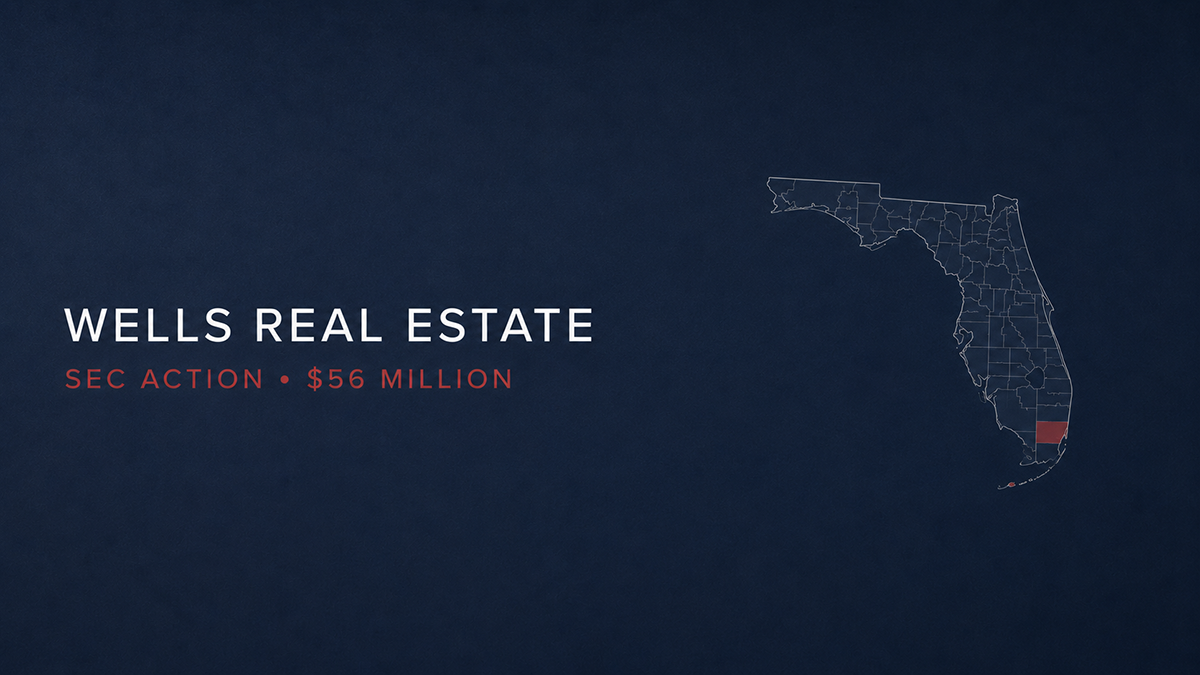
The Securities and Exchange Commission has filed settled actions against Sanders Family Office LLC, its principal Margaret Sanders, and Francisco J. Herrera for their alleged roles in selling promissory notes connected to a $56 million South Florida real estate investment scheme.
According to the SEC, Wells Real Estate Investment LLC raised at least $56 million from approximately 660 investors nationwide. The regulator alleges that Sanders, Herrera, and their respective sales teams helped solicit millions of dollars from investors despite not being registered as broker-dealers or associated with registered brokerage firms.
The new actions were filed on June 23, 2026, in federal courts in Texas and South Florida. The matters expand the SEC’s enforcement action involving Wells Real Estate, company owner Janalie C. Bingham, and her husband, Jean Joseph.
Official sources: SEC litigation release dated June 24, 2026 (www.sec.gov/enforcement-litigation/litigation-releases/lr-26571), original SEC Wells Real Estate action (www.sec.gov/enforcement-litigation/litigation-releases/lr-26079), and Department of Justice criminal case update (www.justice.gov/usao-sdfl/pr/convicted-felon-pleads-guilty-connection-50-million-real-estate-fraud-scheme-0).
Sanders Family Office Allegedly Raised Approximately $40 Million
The SEC alleges that Sanders Family Office and Margaret Sanders directly and through a team of sales agents raised approximately $40 million from around 600 investors between August 2020 and March 2023.
According to the complaint, Sanders and her firm received at least $2.97 million in transaction-based commissions from these sales. Neither Sanders nor Sanders Family Office was allegedly registered as a broker-dealer or associated with a registered brokerage firm.
Without admitting or denying the SEC’s allegations, Sanders and her firm agreed to proposed judgments requiring them to pay approximately $2.98 million in disgorgement and more than $506,000 in prejudgment interest. Sanders also agreed to pay a $100,000 civil penalty.
The proposed settlement remains subject to court approval.
Francisco Herrera Allegedly Used Radio and Online Promotions
The SEC separately alleges that Francisco Herrera personally and through sales agents under his management raised approximately $10 million from around 190 investors between March 2021 and November 2022.
Herrera allegedly promoted the Wells Real Estate promissory notes online and through his radio program. According to the SEC, he received at least $488,244 in transaction-based commissions.
Herrera consented to a proposed judgment without admitting or denying the allegations. The court will determine whether he must pay disgorgement, prejudgment interest, and a civil penalty.
The action against Herrera was filed in the U.S. District Court for the Southern District of Florida.
What Investors Were Allegedly Told
Wells Real Estate allegedly marketed promissory notes as investments connected to residential and commercial real estate projects.
Federal prosecutors have stated that investors were told their money would be used to purchase and improve real estate and that the notes were secured by valuable property holdings. The company allegedly represented that its real estate portfolio was worth as much as $450 million.
According to prosecutors, Wells Real Estate and the defendants did not possess sufficient property to secure the investments. Only a limited portion of investor funds was allegedly used for real estate activities.
Authorities allege that approximately $28 million was instead transferred into speculative equities trading. More than $8 million in money from newer investors was allegedly used to make Ponzi-style payments to earlier investors.
Undisclosed Commissions Present an Additional Warning Sign
Investors were allegedly told that Wells Real Estate did not pay commissions for selling its promissory notes. In reality, prosecutors say the company paid sales commissions reaching as high as 15%.
Approximately $8 million in investor money was allegedly distributed to sales personnel.
Large or undisclosed commissions can create serious conflicts of interest. A salesperson receiving transaction-based compensation may be financially motivated to recommend an investment regardless of whether it is suitable for the investor.
The SEC’s latest actions also underscore the risks of purchasing securities through individuals who are not properly registered to sell investments.
The Original Wells Real Estate Enforcement Action
The SEC originally charged Wells Real Estate, Bingham, and Joseph in August 2024. The agency obtained emergency relief that included an asset freeze and the appointment of a receiver.
The SEC subsequently obtained consent judgments against Bingham and Joseph. Both were also charged criminally and have pleaded guilty.
Federal prosecutors allege that Joseph continued directing aspects of the operation while serving a prison sentence in an unrelated wire-fraud case. Joseph reportedly concealed his involvement in Wells Real Estate because of his prior criminal conviction.
The court-appointed receiver continues working to identify assets and recover money for affected investors. However, regulatory proceedings and receivership distributions may not compensate every investor fully.
Risks Associated With Real Estate Promissory Notes
Promissory notes are frequently marketed as simple, income-producing investments. They may promise fixed interest payments, principal protection, or security through real estate and other tangible assets.
These investments can nevertheless carry substantial risks, particularly when:
- The offering is not registered with securities regulators
- The salesperson is not properly licensed
- Investors cannot independently verify the collateral
- Promised returns appear unusually high or consistent
- Substantial commissions are not disclosed
- The issuer controls all financial reporting
- Interest payments depend on money from new investors
- Investors cannot readily withdraw their principal
The existence of real estate does not guarantee that a promissory note is adequately secured. Investors must determine whether the issuer owns the claimed property, whether liens already encumber it, and whether the collateral has sufficient value to cover the obligation.
Potential Recovery Options for Wells Real Estate Investors
Investors affected by fraudulent promissory-note offerings may have recovery options beyond an SEC enforcement action or receivership claim.
Depending on how the investment was recommended and sold, potential claims may involve unregistered securities sales, material misrepresentations, omitted risks, unsuitable recommendations, undisclosed commissions, negligent supervision, or breaches of applicable duties.
Potentially responsible parties can include promoters, sales agents, investment professionals, brokerage firms, financial institutions, and other participants that facilitated the transactions. The availability of a claim will depend on the investor’s particular circumstances and the applicable filing deadlines.
Investors should preserve their promissory notes, subscription agreements, account statements, offering documents, emails, text messages, advertisements, radio-program information, payment records, and communications with sales representatives.
Speak With an Investment Fraud Attorney
Sonn Law Group represents investors nationwide in cases involving Ponzi schemes, fraudulent promissory notes, real estate investments, unregistered securities offerings, and other forms of financial misconduct.
Investors who purchased Wells Real Estate promissory notes through Sanders Family Office, Margaret Sanders, Francisco Herrera, or another salesperson may contact Sonn Law Group for a confidential review of their potential recovery options.
Learn more:
Past results do not guarantee future outcomes. Each matter depends on its specific facts, available documentation, responsible parties, and applicable law.