Recent SEC, DOJ, and FINRA-related matters show a recurring pattern in investor fraud cases: investments are marketed as safer or more reliable because they are supposedly backed by real estate, hotels, loans, properties, collateral, or income-producing assets.
For many retail investors, that language creates a false sense of comfort. Real estate sounds tangible. A hotel portfolio sounds understandable. A promissory note sounds straightforward. A private lending program may appear more stable than stocks or crypto. But when the underlying offering is misleading, illiquid, overleveraged, or dependent on new investor money, “real estate-backed” can become one of the most dangerous phrases in an investment pitch.
Recent cases involving Wells Real Estate Investment LLC, Sanders Family Office, Drive Planning, Phoenix American Hospitality, and other private investment programs highlight why investors should carefully scrutinize real estate-backed private offerings before assuming their money is protected.
Sources to review include the SEC’s Wells Real Estate litigation release (www.sec.gov/enforcement-litigation/litigation-releases/lr-26079), the SEC’s June 2026 Wells-related sales-agent litigation release (www.sec.gov/enforcement-litigation/litigation-releases/lr-26571), the DOJ’s Wells Real Estate criminal case update (www.justice.gov/usao-sdfl/pr/convicted-felon-pleads-guilty-connection-50-million-real-estate-fraud-scheme-0), and recent public reporting on the Drive Planning / Todd Burkhalter guilty plea involving a Georgia real estate investment scheme.
Why “Backed by Real Estate” Can Be Misleading
Many investors are told that a private investment is secured by real estate or tied to income-producing properties. That may sound reassuring, but the important question is not whether real estate is mentioned in the sales pitch. The real question is whether the investment is actually secured, properly valued, independently verified, and legally enforceable.
Investors should ask:
- Does the issuer actually own the claimed properties?
- Are the properties already encumbered by liens or debt?
- Is there an independent appraisal?
- Does the investor have a recorded security interest?
- Are the promised returns supported by actual operating income?
- Are distributions coming from profits or from new investor money?
In many fraud cases, investors are told that their money is tied to real estate when, in reality, the collateral is overstated, nonexistent, already pledged, or insufficient to protect investors from loss.
Promissory Notes and Fixed-Return Claims
Promissory notes are often marketed as simple, income-producing investments. Investors may be promised fixed interest payments, repayment of principal, and security through real estate or other assets.
The Wells Real Estate matter illustrates the risk. According to regulators and prosecutors, investors were allegedly told that their money would be used for residential and commercial real estate projects and that the notes were backed by valuable property holdings. Authorities alleged that Wells Real Estate raised at least $56 million from approximately 660 investors nationwide, while investor money was allegedly misused, diverted, and used to make Ponzi-style payments.
Promissory-note fraud often includes familiar warning signs:
- Promised fixed returns that seem unusually consistent
- Claims that the investment is “safe” or “secured”
- Lack of audited financials
- Limited transparency into collateral
- Undisclosed commissions
- Sales through unregistered agents
- Payments to earlier investors funded by newer investors
The existence of a promissory note does not guarantee repayment. Investors must examine whether the issuer has the financial ability and legal obligation to repay the debt.
Reg A and Retail Real Estate Offerings
Regulation A offerings can give retail investors access to private-market opportunities, including real estate funds, hospitality investments, and other alternative investments. These offerings may be promoted online and marketed to a broad investor base.
That expanded access can create real risk when investors do not fully understand the structure, fees, conflicts, liquidity limits, or financial condition of the issuer.
The Phoenix American Hospitality matter has drawn attention because it reportedly involved a Regulation A hotel offering that raised approximately $86 million from more than 2,000 retail investors. The case is significant because it combines several investor-risk themes: hotel assets, private offering documents, retail investor access, income distributions, and alleged misrepresentations about the company’s financial condition.
For investors, the key lesson is that a Reg A offering is not automatically safe simply because it went through a regulatory filing process. Investors still need to understand what they own, how the sponsor makes money, whether distributions are supported by actual profits, and whether the offering is suitable for their financial situation.
Undisclosed Commissions and Unregistered Sales Activity
Another common problem in private real estate offerings is the use of sales agents, promoters, referral networks, or investment marketers who receive transaction-based compensation.
In the Wells Real Estate-related actions, the SEC alleged that Sanders Family Office, Margaret Sanders, and Francisco Herrera helped raise millions of dollars for Wells Real Estate promissory notes while not registered as broker-dealers. The SEC alleged that Sanders Family Office and Margaret Sanders raised approximately $40 million from around 600 investors, while Herrera allegedly raised approximately $10 million from around 190 investors.
Large or undisclosed commissions matter because they may create conflicts of interest. A salesperson who receives compensation only when an investor purchases the product may have a financial incentive to push the investment regardless of whether it is suitable.
Investors should be especially cautious when they are not clearly told:
- Who is being paid to sell the investment
- How much compensation is being paid
- Whether the salesperson is properly licensed
- Whether the salesperson conducted due diligence
- Whether the investment was reviewed by a registered broker-dealer or adviser
Fake Income Distributions and Ponzi-Style Payments
One of the most dangerous features of real estate-backed investment fraud is the appearance of income.
Investors may receive monthly or quarterly payments and assume the investment is performing. But those payments may not come from rental income, hotel revenue, interest payments, or legitimate business profits. In some cases, distributions are funded by money from new investors.
That creates a dangerous illusion. Investors believe the investment is successful, continue holding the product, reinvest distributions, or refer friends and family. Meanwhile, the underlying business may be deteriorating or may never have existed as represented.
This is why investors should not rely only on payment history. They should review financial statements, bank records, offering documents, property records, and independent reporting to determine whether distributions are supported by real economic activity.
Drive Planning and the Real Estate Credibility Problem
The Drive Planning case is another example of how real estate language can be used to attract investors. Federal prosecutors in Georgia announced that Todd Burkhalter pleaded guilty in connection with a scheme involving more than 2,000 investors and approximately $380 million. The investment programs were allegedly marketed as real estate-related opportunities promising high returns. Public reporting indicates prosecutors said investors were encouraged to use savings, retirement funds, and lines of credit.
These cases are especially harmful because the sales pitch often appears professional and credible. Investors may see polished branding, experienced operators, impressive property descriptions, referral networks, sponsorships, webinars, or repeated “income” payments. That credibility can delay suspicion and magnify losses.
Broker and Adviser Responsibility
Even when the issuer or sponsor is the main wrongdoer, investors should examine how the investment was sold.
If a registered broker, brokerage firm, investment adviser, or financial professional recommended a real estate-backed private offering, investors may have potential claims depending on the facts. These claims may involve unsuitable recommendations, misrepresentations, omitted risks, failure to supervise, selling away, negligence, or violations of Regulation Best Interest.
Brokerage firms and advisers are expected to understand the investments they recommend. They cannot rely blindly on marketing materials, projected returns, sponsor reputation, or the existence of real estate collateral.
Important questions include:
- Did a broker or adviser recommend the investment?
- Was the product suitable for the investor’s age, income, risk tolerance, liquidity needs, and investment objectives?
- Were risks of illiquidity and principal loss clearly explained?
- Were commissions or conflicts disclosed?
- Was the investor overconcentrated in private real estate or alternative investments?
- Did the firm conduct reasonable due diligence?
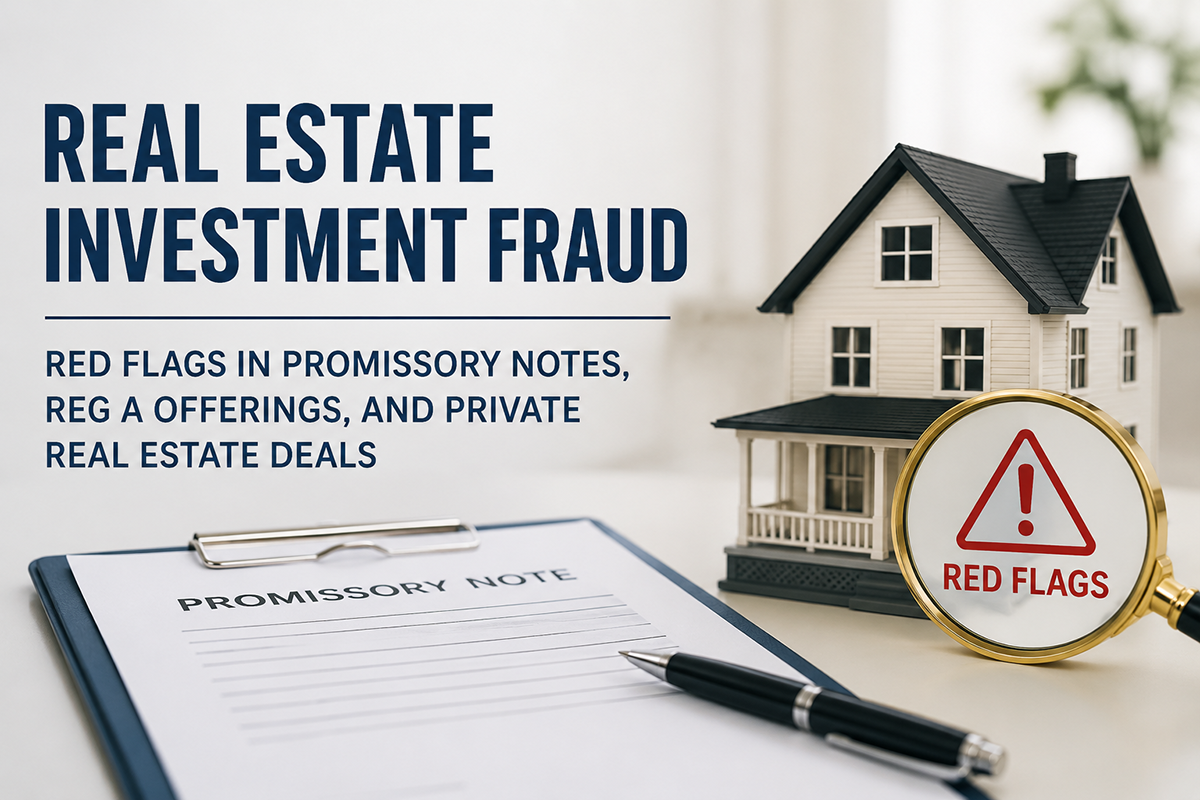
Red Flags Investors Should Watch For
Investors should be cautious when a real estate-backed offering includes any of the following warning signs:
- Promised high or fixed returns
- Claims that the investment is safe, secured, or guaranteed
- Pressure to invest quickly
- Limited ability to verify the collateral
- No independent appraisal or audited financials
- Unclear use of investor proceeds
- Complex entity structures
- Undisclosed commissions or referral fees
- Payments described as income without proof of actual profits
- Use of retirement funds to purchase illiquid products
- Sales through unregistered agents or promoters
- Difficulty obtaining account statements or financial updates
These red flags do not automatically prove fraud, but they justify a deeper review.
What Investors Should Do After a Loss
Investors who purchased promissory notes, Reg A offerings, private placements, real estate funds, hotel investments, DSTs, non-traded REITs, or other alternative investments should preserve all documents connected to the transaction.
Important records include:
- Subscription agreements
- Promissory notes
- Offering memoranda
- Private placement memoranda
- Account statements
- Investor presentations
- Emails and text messages
- Marketing materials
- Distribution records
- Wire confirmations
- Communications with brokers, advisers, promoters, or sales agents
A proper review may examine whether the investment was misrepresented, whether the investor was told the product was safer than it was, whether commissions were disclosed, and whether any financial professional or firm may be responsible for the losses.
Sonn Law Group Investigates Real Estate-Backed Investment Losses
Sonn Law Group represents investors nationwide in cases involving securities fraud, broker misconduct, FINRA arbitration, promissory note fraud, real estate investment fraud, Reg A offering losses, private placement losses, Ponzi schemes, and unsuitable alternative investments.
Investors who suffered losses in real estate-backed private offerings may contact Sonn Law Group for a confidential review of their potential recovery options.
Learn more:
Past results do not guarantee future outcomes. Each matter depends on its specific facts, documentation, responsible parties, and applicable law.