Investors who have sustained substantial losses in brokerage accounts may have questions about whether their broker’s recommendations, trading activity, or supervision complied with FINRA rules and federal securities regulations.
This FINRA broker misconduct watchlist summarizes selected public FINRA disciplinary actions and a pending FINRA enforcement complaint involving allegations and findings related to unsuitable recommendations, excessive trading, churning, unauthorized discretion, and senior-investor concerns.
Sonn Law generally evaluates FINRA arbitration matters involving $100,000 or more in investor losses. A FINRA regulatory action does not automatically establish that every customer has a recoverable claim. But public FINRA records can identify important warning signs and help investors determine whether their account activity deserves a closer review.
Important disclaimer: This article summarizes public regulatory records. A FINRA complaint contains allegations that have not been proven or adjudicated. A broker or respondent named in a FINRA complaint may contest the allegations. Final FINRA settlements may be entered without admitting or denying findings. The complete official source report is available from FINRA here.
1. Keith Michael Dagostino: FINRA Reports More Than $1.8 Million in Customer Losses
FINRA reported a final disciplinary action involving Keith Michael Dagostino (CRD No. 2837860), who consented to sanctions without admitting or denying FINRA’s findings.
According to FINRA, Dagostino willfully violated the Care Obligation under Regulation Best Interest, commonly called Reg BI, by recommending speculative and low-priced microcap securities to retired and senior investors. FINRA stated that these customers had low risk tolerances and investment objectives centered on capital preservation and retirement income.
FINRA further stated that the recommendations caused more than $1.8 million in customer losses. The firm repaid the customers for realized losses. FINRA imposed a deferred $25,000 fine and a 24-month suspension.
This action is especially relevant to investors who were placed in speculative investments despite conservative objectives, retirement needs, limited risk tolerance, or a stated need to preserve capital.
FINRA case number: 2022075471001
Source: FINRA, Disciplinary and Other FINRA Actions — February 2026.
2. Charles Henry Garrido: Unauthorized Discretion in Approximately 2,500 Trades
FINRA issued a final action involving Charles Henry Garrido (CRD No. 1191231). Without admitting or denying FINRA’s findings, Garrido consented to sanctions that included a $10,000 fine and a three-month suspension.
FINRA found that Garrido exercised discretion without written authorization in approximately 2,500 trades involving more than 200 customer accounts. FINRA stated that customers understood he was conducting trading in their accounts, but the accounts were not accepted as discretionary by the firm and the customers had not provided prior written authorization.
Unauthorized trading can be a serious concern, particularly when it results in unexpected losses, excessive commissions, a portfolio inconsistent with the customer’s risk profile, or trades that the investor did not understand or approve.
FINRA case number: 2023077059102
Source: FINRA, Disciplinary and Other FINRA Actions — February 2026.
3. Ronald Ray Botello: $173,000 Borrowed From Senior Retail Customers
FINRA issued a final disciplinary action involving Ronald Ray Botello (CRD No. 4809045). Without admitting or denying FINRA’s findings, Botello consented to a deferred $5,000 fine and a three-month suspension.
FINRA found that Botello borrowed a total of $173,000 from two senior retail customers without notifying or obtaining approval from his brokerage firm. FINRA stated that the loans were undocumented and did not include interest payments, although the funds were later repaid.
Borrowing money from brokerage customers can create conflicts of interest and may raise important questions regarding supervision, customer vulnerability, the purpose of the transaction, and whether the brokerage firm followed its own procedures.
Source: FINRA, Disciplinary and Other FINRA Actions — February 2026.
4. James Robert Pecoraro: FINRA Complaint Alleges Churning and Excessive Trading
James Robert Pecoraro (CRD No. 2440231) was named as a respondent in a FINRA enforcement complaint involving Spartan Capital Securities, LLC.
FINRA alleged that, over more than four years, the firm engaged in widespread churning that generated millions of dollars in revenue and caused customers millions of dollars in harm. FINRA further alleged that Pecoraro and other respondents engaged in conduct involving excessive trading, unsuitable recommendations, and recommendations that did not place customers’ interests first.
The complaint alleges violations involving Section 10(b) of the Securities Exchange Act, SEC Rule 10b-5, and Regulation Best Interest. These allegations have not been adjudicated.
For investors, common red flags of possible churning include unusually frequent trades, high commissions, high account turnover, repeated buying and selling of the same securities, and account activity that seemed designed to generate broker compensation rather than advance the investor’s goals.
FINRA case number: 2018056490335
Status: Pending FINRA complaint; allegations have not been adjudicated.
Source: FINRA, Disciplinary and Other FINRA Actions — February 2026.
5. John Joseph Stapleton: FINRA Complaint Alleges Churning and Reg BI Violations
John Joseph Stapleton (CRD No. 2791194) was also named in FINRA’s complaint against Spartan Capital Securities.
FINRA alleged that Stapleton, along with other respondents, participated in churning customer accounts and made recommendations that were excessive and not in customers’ best interests. The complaint further alleges violations of Regulation Best Interest based on the alleged failure to exercise reasonable diligence, care, and skill before recommending a series of securities transactions.
These are allegations, not final FINRA findings. Still, customers who experienced substantial losses, excessive trading costs, frequent recommendations, or trading they did not fully understand may wish to have their account statements reviewed.
FINRA case number: 2018056490335
Status: Pending FINRA complaint; allegations have not been adjudicated.
6. Michael A. Darvish: FINRA Complaint Alleges Quantitatively Unsuitable Trading
FINRA named Michael A. Darvish (CRD No. 3243141) in the Spartan Capital enforcement complaint.
According to FINRA’s complaint, Darvish and other respondents allegedly recommended trading that was excessive and quantitatively unsuitable in light of customer investment profiles. FINRA referenced high turnover rates, high cost-to-equity ratios, frequent transactions, and transaction costs as evidence supporting its allegations.
Quantitative suitability focuses on the overall pattern of transactions in an account. Even if individual trades appear acceptable in isolation, the trading strategy may be unsuitable if the cumulative activity is excessive for the client’s objectives and account size.
FINRA case number: 2018056490335
Status: Pending FINRA complaint; allegations have not been adjudicated.
7. Frederick Joseph Cammarano III: FINRA Complaint Alleges Supervisory Failures
Frederick Joseph Cammarano III (CRD No. 2277307) was named in FINRA’s pending complaint involving Spartan Capital Securities.
FINRA alleged that Cammarano and another respondent failed to reasonably investigate and address red flags associated with alleged excessive trading and churning. Brokerage firms and their supervisory personnel have obligations to maintain reasonable supervisory systems and respond appropriately when potential misconduct comes to light.
In a FINRA arbitration claim, the brokerage firm’s supervision may be as important as the conduct of an individual broker. A firm may face responsibility where it did not reasonably detect, investigate, or stop excessive trading, unsuitable recommendations, or other misconduct.
FINRA case number: 2018056490335
Status: Pending FINRA complaint; allegations have not been adjudicated.
8. Kim Marie Monchik: FINRA Complaint Alleges Failure to Address Churning Red Flags
Kim Marie Monchik (CRD No. 2528972) was named in FINRA’s Spartan Capital enforcement complaint.
FINRA alleged that Monchik and another supervisory respondent failed to reasonably investigate and address red flags related to alleged excessive trading and churning. The allegations remain pending and should not be treated as final findings.
For investors, this issue matters because broker-dealers must have systems designed to identify potentially problematic trading activity. If account statements show unusually high trading volume, commissions, turnover, or losses, an investor may have questions not only about the broker’s conduct but also about whether the firm reasonably supervised the account.
FINRA case number: 2018056490335
Status: Pending FINRA complaint; allegations have not been adjudicated.
Sources and Regulatory Status: The matters summarized in this article are drawn from public FINRA disciplinary records and enforcement filings. Final disciplinary actions may be resolved through settlements in which a respondent neither admits nor denies FINRA’s findings. References to the Spartan Capital Securities matter concern allegations in a pending FINRA complaint; those allegations have not been adjudicated and should not be treated as findings of wrongdoing. Readers can review the underlying official FINRA report, including case numbers and disciplinary descriptions, here: FINRA Disciplinary and Other FINRA Actions – February 2026.
Potential Signs of a FINRA Arbitration Claim
Investors with substantial brokerage-account losses may benefit from reviewing their accounts when they experienced:
- Losses of $100,000 or more;
- frequent buying and selling that generated substantial commissions or fees;
- recommendations inconsistent with retirement, income, preservation-of-capital, or conservative-investment objectives;
- trades the investor did not authorize or understand;
- speculative investments in accounts held by retirees or senior investors;
- repeated broker requests to borrow money;
- high account turnover or unusually high cost-to-equity ratios; or
- brokerage-firm failures to investigate or address obvious warning signs.
Contact Sonn Law About a Potential FINRA Arbitration Claim
Sonn Law represents investors in FINRA arbitration and securities-related disputes. If you lost $100,000 or more because of excessive trading, churning, unsuitable recommendations, unauthorized trades, speculative investments, or brokerage-firm supervision failures, our attorneys can review the facts of your potential claim.
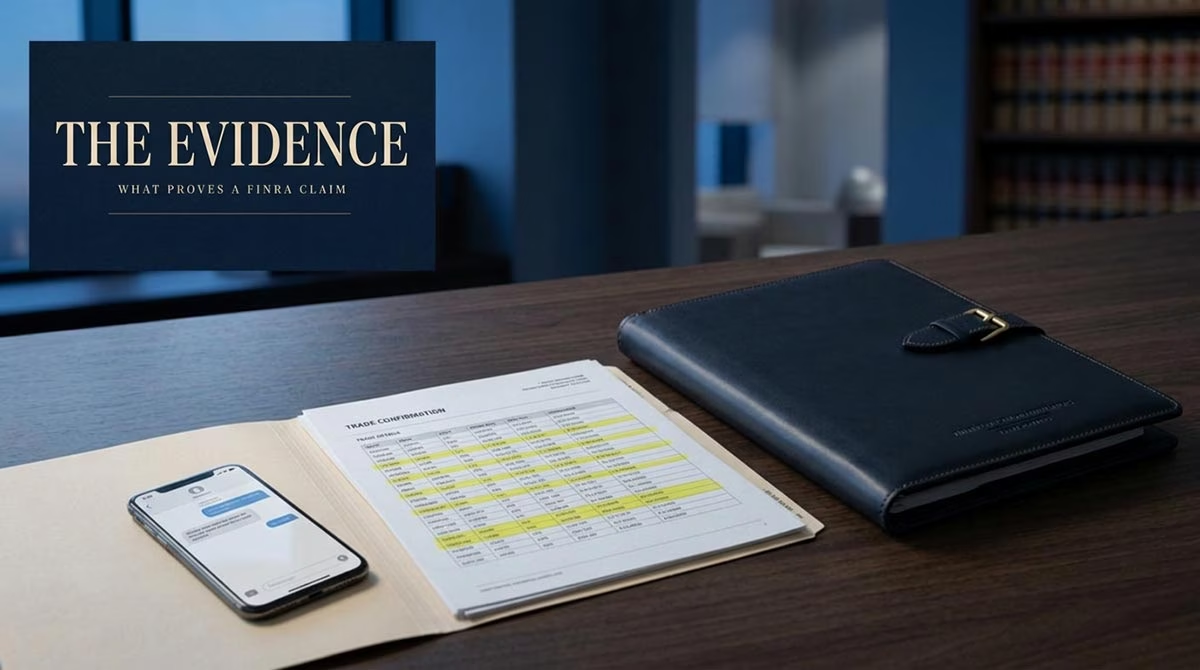
Preserve your brokerage statements, trade confirmations, communications with the broker, account-opening documents, and any available BrokerCheck reports before seeking a case review.