In our recent briefing on Cottonwood Communities and the 2026 non-traded BDC liquidity freeze, we examined how dividend cuts and quarterly withdrawal caps have locked thousands of retail investors inside illiquid alternative funds. Over the past few weeks, that liquidity crunch has widened across the biggest names in private credit, including Blue Owl Credit Income Corp. (OCIC), Ares Strategic Income Fund (ASIF), and Blackstone Private Credit Fund (BCRED).
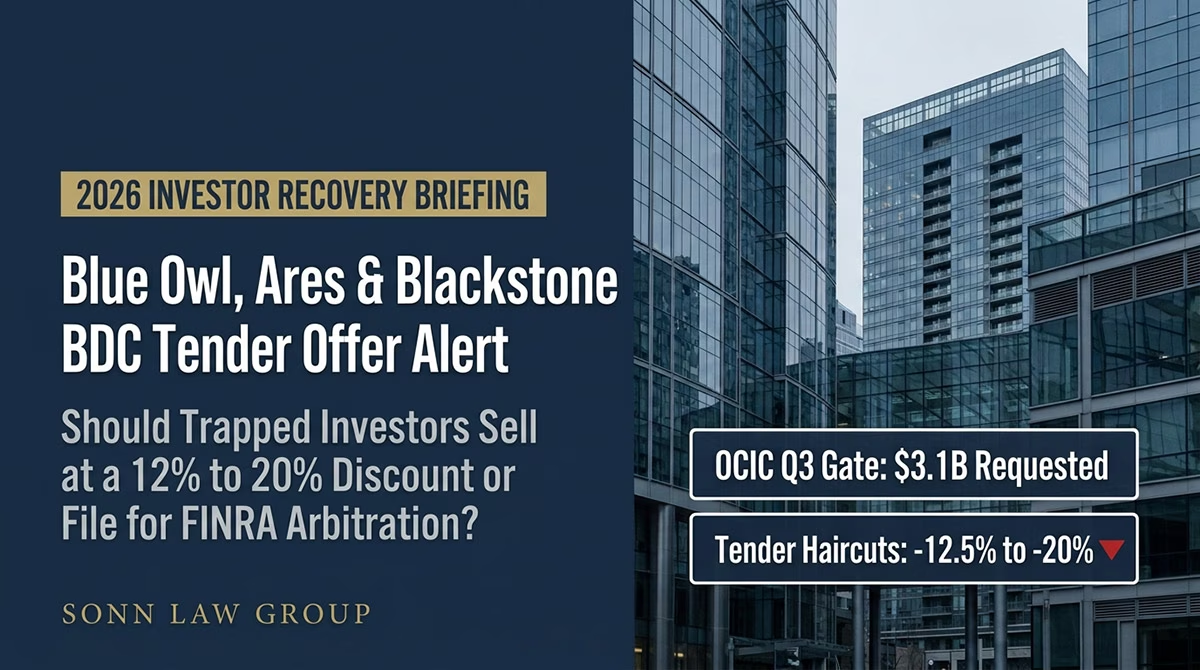
As redemption queues grow longer, a secondary trend has emerged. Trapped shareholders are receiving official-looking mailers from third-party investment firms like Cox Capital Partners and MacKenzie Realty Capital offering immediate cash for their shares, but only if the investor agrees to take an immediate 12% to 20% loss below the fund’s stated net asset value (NAV).
At Sonn Law Group, we regularly speak with retirees and high-net-worth investors who are tempted to sign these discounted buyout offers just to get their money back. Before you lock in a permanent haircut on your retirement savings, here is what the latest SEC filings reveal about the private credit bottleneck and how you can pursue a full recovery from the brokerage firm that sold you the fund.
1. The $3.1 Billion Bottleneck at Blue Owl Credit Income Corp. (OCIC)
For years, financial advisors at major wirehouses and regional broker-dealers pitched Blue Owl’s flagship non-traded business development company, Blue Owl Credit Income Corp. (OCIC), as a dependable income generator backed by senior secured corporate loans. Advisors routinely emphasized that the fund offered quarterly liquidity through its share repurchase program.
In the second half of 2026, that exit door narrowed dramatically:
- Record Q3 2026 Withdrawal Surge: Investors submitted repurchase requests for roughly 15.5% of OCIC’s total shares (approximately $3.1 billion) during the third quarter of 2026, jumping from $1.9 billion the quarter before.
- The 5% Gate Kicks In: Because OCIC caps quarterly redemptions at 5% of aggregate NAV, the fund returned roughly $1.0 billion and prorated everyone in line. Investors who asked for their money back received less than a third of what they requested.
- Another Blue Owl Tech Fund Prorated: Blue Owl’s sister non-traded BDC, Blue Owl Technology Income Corp. (OTIC), also hit its 5% quarterly cap in the third quarter of 2026 after withdrawal requests reached 7.6% of the fund, returning roughly 66 cents on the dollar for requested redemptions.
- Shutter of Blue Owl Capital Corp. II (OBDC II): Earlier in 2026, Blue Owl permanently closed quarterly redemptions at OBDC II and replaced them with periodic return-of-capital distributions after calling off a planned merger that would have forced shareholders to take an immediate 20% haircut.
2. Redemption Pressure Reaches Ares (ASIF) and Blackstone (BCRED)
Blue Owl is not an outlier. Across Wall Street’s flagship private credit funds, retail investors are rushing for the exits at the exact same time:
- Ares Strategic Income Fund (ASIF): After investor redemption requests climbed to 5.6% of total shares in the second quarter of 2026 and rose further to 7.8% in the third quarter, Ares enforced its 5% quarterly repurchase limit. That left millions of dollars in investor exit requests unfulfilled.
- Blackstone Private Credit Fund (BCRED): As the largest non-traded BDC on the market, BCRED saw quarterly withdrawal requests hit a record $2.9 billion (roughly 7.9% of the fund) earlier in 2026, followed by another $2.1 billion in third-quarter outflows. While Blackstone took the unusual step of expanding an April tender offer and investing $400 million of its own employee and firm capital to keep BCRED from formally gating investors, the sheer volume of outflows across the sector shows how quickly liquidity can evaporate in private credit.
3. How Predatory “Mini-Tender” Offers Exploit Gated Investors
Whenever a multi-billion-dollar REIT or BDC begins prorating withdrawals at 5% per quarter, opportunistic secondary buyers immediately review public shareholder registries and launch unsolicited “mini-tender” offers. Because these offers seek less than 5% of a company’s total stock, they bypass many of the investor-protection rules that the SEC applies to full-scale corporate buyouts.
In recent SEC filings for Blue Owl (OCIC) and Ares (ASIF), third-party buyer Cox Capital Partners launched mini-tender offers proposing to buy retail shares at roughly 12.5% to 13% below reported NAV, matching the steep 14.6% to 17.5% discounts offered to trapped shareholders in Apollo Debt Solutions BDC and HPS Corporate Lending Fund this November.
The Boards of Directors for both Blue Owl and Ares filed formal Schedule 14D-9 notices urging shareholders to reject the Cox Capital offers. However, the funds’ boards cannot solve the core problem that makes investors consider these lowball offers in the first place: if a fund stays gated at 5% per quarter while 15% of shareholders are trying to leave, it can take an investor a year and a half or longer just to liquidate their position.
4. Why a FINRA Arbitration Claim Beats Selling at a Steep Discount
If you need access to your capital because of retirement needs, medical expenses, or concern over deteriorating private credit loans, you do not have to choose between staying trapped for years and handing 15% to 25% of your life savings over to a third-party liquidator.
There is a third path: holding the brokerage firm that sold you the product accountable through FINRA arbitration.
Under the SEC’s Regulation Best Interest (Reg BI) and FINRA Rule 2111, financial advisors are prohibited from treating complex, semi-liquid private credit funds as one-size-fits-all bond replacements. When our attorneys audit portfolios containing Blue Owl, Ares, Blackstone, Apollo, or HPS funds, we frequently uncover two clear violations:
- Point-of-Sale Misrepresentation of Liquidity: Advisors regularly tell conservative clients that non-traded BDCs offer “quarterly liquidity” without explaining that the 5% cap is calculated across the entire fund, not per individual investor. Most retail investors are stunned to learn that when market anxiety hits and other customers want out at the same time, their own access to cash is rationed down to pennies on the dollar.
- Improper Overconcentration in Alternatives: Even when an investor can afford to tie up a small slice of their portfolio in private credit, brokerage firms frequently violate their supervisory duties under FINRA Rule 3110 by allowing brokers to pack 20%, 30%, or even 50% of a retiree’s liquid net worth into a bucket of non-traded REITs and BDCs that all freeze up during the same economic cycle.
Frequently Asked Questions
Does accepting a third-party tender offer prevent me from suing my brokerage firm?
It does not automatically bar you from filing a FINRA arbitration claim, because selling at a discounted tender price actually locks in a hard, realized out-of-pocket loss. However, the brokerage firm’s defense lawyers will almost certainly argue that you “voluntarily” chose to sell at a discount rather than waiting in the quarterly redemption queue. That is why it is critical to speak with a securities litigation attorney before you sign any tender offer paperwork.
Why did my financial advisor put me in a non-traded BDC instead of a public bond fund?
In many cases, the incentive is higher upfront fees and trailing commissions. Publicly traded bond ETFs and Treasury ladders are completely liquid and cost pennies to buy, whereas non-traded BDCs and private placements often reward brokerage firms and wealth managers with lucrative placement fees, dealer-manager fees, and ongoing shareholder servicing payouts.
How fast can senior investors move a claim through FINRA arbitration in 2026?
Thanks to FINRA Rule 12808, which became mandatory on March 30, 2026, any investor who is 70 or older or who certifies a serious health condition is entitled to an accelerated arbitration schedule with shortened deadlines for document production and final hearings.
Speak With a Securities Litigation Attorney at Sonn Law Group
If you are holding gated shares of Blue Owl Credit Income Corp. (OCIC), Blue Owl Technology Income Corp. (OTIC), Ares Strategic Income Fund (ASIF), Blackstone Private Credit Fund (BCRED), or another non-traded BDC or REIT, do not sign away your investment at a steep discount before learning your legal rights.
Sonn Law Group represents individual and institutional investors nationwide in FINRA arbitration claims against the brokerage firms and wealth managers that improperly sold illiquid alternative investments. We work on a contingency-fee basis, meaning you pay no legal fees unless we recover compensation for you. Contact our office today for a free, confidential evaluation of your holdings.