Over the last five years, Wall Street brokerage firms and independent wealth managers poured more than $100 billion of retail investor money into non-traded real estate investment trusts (REITs) and non-traded business development companies (BDCs). Financial advisors frequently pitched these complex private funds to retirees as safe, high-yield alternatives to traditional bonds or certificates of deposit, promising steady monthly checks and easy quarterly liquidity.
In late 2026, that sales pitch has collided with reality. Across the alternative investment market, fund boards are slashing distributions, rationing investor withdrawals behind strict 5% quarterly gates, or shutting down share repurchase programs altogether. At the same time, opportunistic third-party buyers are circling trapped shareholders with predatory tender offers at steep discounts to stated net asset value (NAV).
At Sonn Law Group, we are investigating potential FINRA arbitration claims on behalf of investors who were sold Cottonwood Communities, Apollo Debt Solutions BDC, HPS Corporate Lending Fund, Starwood Real Estate Income Trust (SREIT), and similar illiquid products without a full, honest explanation of the risks.
1. Cottonwood Communities Cuts Common Distributions Again and Loads Up on Senior Capital
The latest warning sign for non-traded REIT investors arrived in a series of late October and early November 2026 SEC filings from Cottonwood Communities, Inc. (CWREIT), a $1.1 billion multifamily non-traded REIT. (SEC)
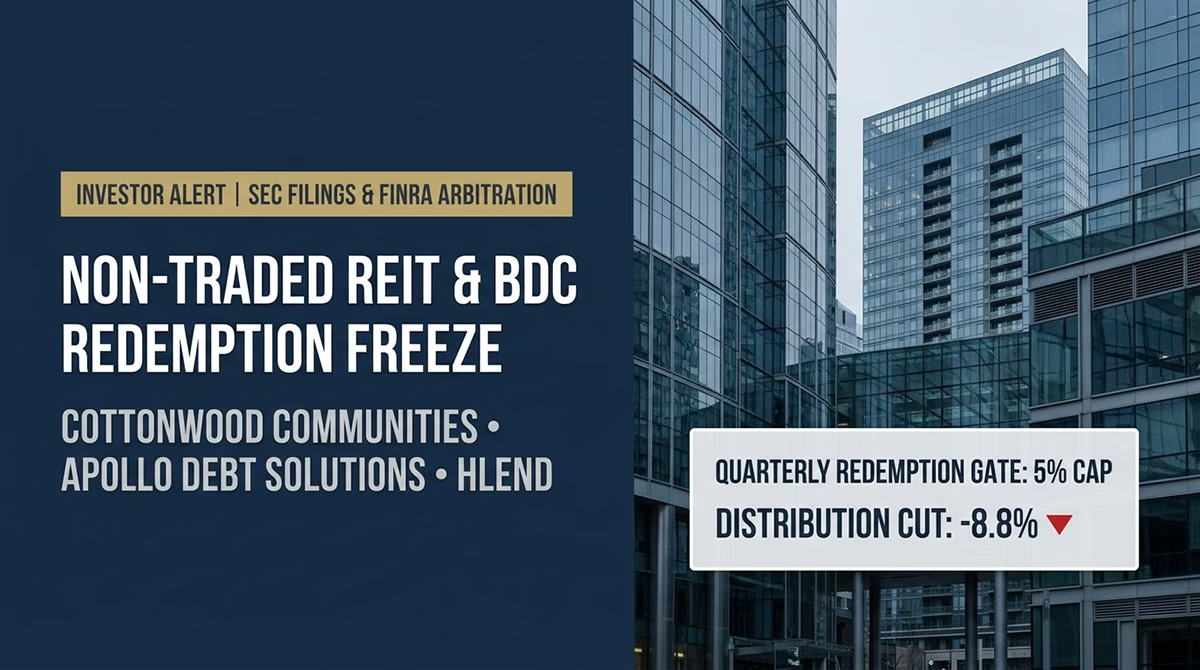
In an October 16, 2026 Form 8-K filing, Cottonwood’s board approved an 8.8% cut to its monthly common stock distribution, lowering the payout from $0.0567 per share to $0.0517 per share starting with the November 30, 2026 record date. Based on Cottonwood’s reported September 30, 2026 NAV of $11.33 per share, the new distribution equals roughly 5.5% annualized. This marks Cottonwood’s second distribution reduction since mid-2025, down from the $0.73 annualized rate the REIT paid between 2023 and July 2025.
What makes the common dividend cut even more concerning for retail shareholders is what is happening higher up in Cottonwood’s capital stack:
- New Bank Debt: On the same day it announced the dividend reduction, Cottonwood’s operating partnership signed a new loan agreement with JPMorgan Chase Bank featuring a $75 million term loan and a $100 million revolving credit line.
- $176 Million in High-Commission Preferred Stock: Public filings through November 4, 2026 show that Cottonwood has filed 95 separate Form 8-K reports since January 2025 disclosing the private sale of $176 million in preferred stock. Those preferred shares carry a hefty 7.5% load in selling commissions and placement fees for the brokers pushing them, and they sit ahead of everyday common shareholders when it comes to cash flow and liquidation priority.
When a non-traded REIT has to borrow from banks and issue expensive preferred equity while trimming distributions to common shareholders, retail investors who were promised “stable, bond-like income” are left holding the bag.
2. The November 2026 Non-Traded BDC Liquidity Bottleneck: Apollo Debt Solutions and HPS Corporate Lending Fund
The liquidity crunch is no longer limited to commercial real estate. Non-traded BDCs, which pool retail investor money to make high-risk private credit loans to mid-sized businesses, grew from $3.5 billion in 2020 to more than $63 billion by 2025. Now, investors trying to pull their money out are hitting a wall.
Most non-traded BDCs cap quarterly share buybacks at 5% of the fund’s total shares. When redemption requests pass that 5% mark, the fund prorates every request, returning only a fraction of what investors asked for and forcing them to get back in line the following quarter.
Two of the largest private credit funds in the country are highlighting this bottleneck right now:
- Apollo Debt Solutions BDC: After redemption requests surged to a record 16.8% of net assets in the second quarter of 2026 and remained near 14.7% in the third quarter, Apollo enforced its 5% quarterly cap. That left roughly two-thirds of investor exit requests unpaid. Taking advantage of trapped shareholders, outside buyer Cox Capital Partners launched a discounted tender offer (expiring November 14, 2026) offering to buy Class I shares at $20.35 per share, which is a 14.6% haircut below the fund’s reported $23.84 NAV.
- HPS Corporate Lending Fund (HLEND): Investors in HLEND requested redemptions of roughly 13.3% of outstanding shares in Q2 2026 and another 11.5% in Q3 2026, forcing the fund to prorate withdrawals. Just like with Apollo, Cox Capital Partners stepped in with a secondary tender offer (expiring in early November 2026) at $20.17 per share, representing a 17.5% discount to HLEND’s reported $24.45 NAV.
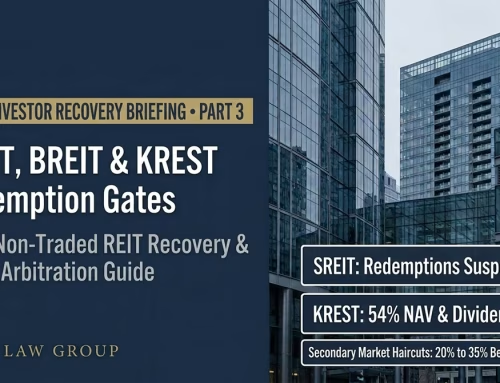
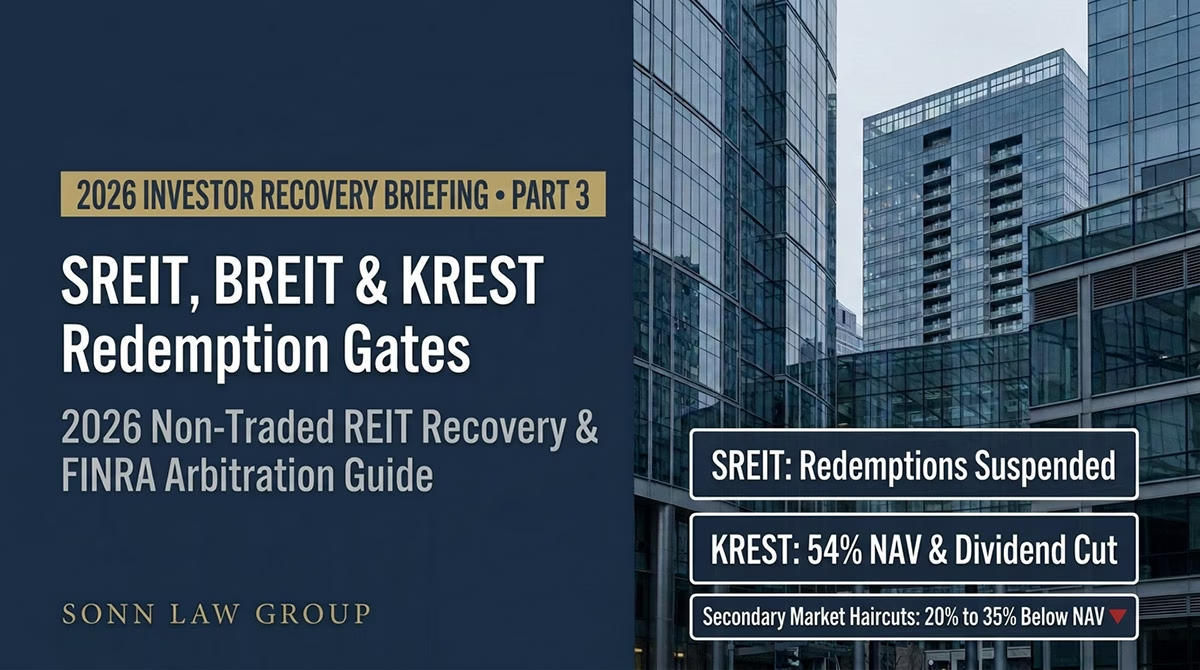
- Starwood Real Estate Income Trust (SREIT): For investors wondering how bad a redemption gate can get, SREIT moved from rationing withdrawals to a full suspension of its share repurchase program on April 30, 2026, while cutting its Class I distribution from 6.3% to 4.7%. Because there is no SEC deadline requiring a non-traded REIT to reopen redemptions, SREIT shareholders seeking immediate cash are currently facing secondary-market offers at 22% to 25% below stated NAV.
3. Why Brokerage Firms Are Liable When “Liquid” Alternatives Freeze Up
If you are stuck in a gated non-traded REIT or BDC, do not rush to sell your shares to a third-party tender-offer firm at a 15% to 30% loss before speaking with a securities attorney.
Under the SEC’s Regulation Best Interest (Reg BI) and FINRA Rule 2111 (Suitability), brokerage firms and financial advisors have a strict duty to match investments to your actual age, liquidity needs, and risk tolerance. They are also prohibited from overconcentrating a conservative portfolio in illiquid alternative products.
Why do advisors push these funds so aggressively? In many cases, it comes down to compensation. While a traditional vanguard index fund or Treasury bond pays a broker next to nothing, non-traded REITs, private placements, and alternative offerings regularly pay 6% to 10% in upfront selling commissions and dealer-manager fees.
We repeatedly see cases where advisors told retired clients:
- That a non-traded REIT or BDC was “as safe as a bond” or “principal-protected.”
- That they could get all of their money out whenever they needed it through the quarterly repurchase program.
- That the stated NAV was a guaranteed value, without explaining that the fund’s board could freeze redemptions indefinitely during market stress.
4. A Wider Pattern of Brokerage Supervision Failures in November 2026
The trouble in the alternative investment market is happening alongside a broader wave of supervisory breakdowns at major broker-dealers this month.
Earlier this week, federal prosecutors and securities blogs highlighted the guilty plea of former MML Investors Services (MassMutual) associated person Trevor Uhls in Missouri, who admitted to running a $3.8 million Ponzi scheme involving fake short-term real estate promissory notes sold to at least 60 investors. Victims’ attorneys noted that Uhls operated out of an MML branch office and used the firm’s email and electronic signature systems to make the notes look legitimate. And on November 5, 2026, FINRA hit Webull Financial with a $4.2 million fine after finding the firm approved more than 120,000 accounts without properly verifying customer identities and missed hundreds of unauthorized transfers.
Whether a loss comes from a gated billion-dollar fund like Cottonwood Communities or an unapproved promissory note pitched out of a local branch office, the legal principle in FINRA arbitration is the same: under FINRA Rule 3110, the brokerage firm that employed the advisor is legally required to supervise what is being sold to its clients and can be held financially responsible when it drops the ball.
Frequently Asked Questions
Should I accept a discounted tender offer from Cox Capital or MacKenzie Realty to get out of my REIT or BDC?
Before signing away your shares at a 15% to 25% discount, have a FINRA arbitration attorney review your account. If your brokerage firm recommended an unsuitable investment or misrepresented its liquidity, you can file a FINRA arbitration claim seeking full recovery of your principal loss or rescission of the investment directly from the brokerage firm.
Can I file a claim if my account statement still shows a high NAV for my non-traded REIT or BDC?
Yes. Brokerage statements often display an issuer-estimated NAV that does not reflect what you can actually get for the shares in the real world once redemptions are gated or suspended. FINRA arbitration panels regularly hear expert testimony on the true realizable value of illiquid investments and can award damages even while a fund remains frozen.
Do senior investors have to wait years for a FINRA arbitration to finish?
Not anymore. Under FINRA Rule 12808, which took effect on March 30, 2026, investors who are at least 70 years old or who are dealing with a serious medical condition qualify for mandatory accelerated timelines throughout the arbitration process.
- Apollo Debt Solutions BDC (SEC EDGAR Filings): SEC
- HPS Corporate Lending Fund / HLEND (SEC EDGAR Filings): SEC
- Starwood Real Estate Income Trust, Inc. / SREIT (SEC EDGAR Filings): SEC
Speak With an Investment Fraud Attorney at Sonn Law Group
If your financial advisor placed a large portion of your retirement savings into Cottonwood Communities, Apollo Debt Solutions BDC, HPS Corporate Lending Fund, Starwood REIT, or another illiquid alternative investment without clearly explaining that your money could be locked up, you may have a strong claim for recovery.
Sonn Law Group represents defrauded and misled investors nationwide in FINRA arbitration and securities litigation. We work on a contingency-fee basis, meaning you pay nothing unless we recover money on your behalf. Contact our office today for a free, confidential review of your portfolio.