
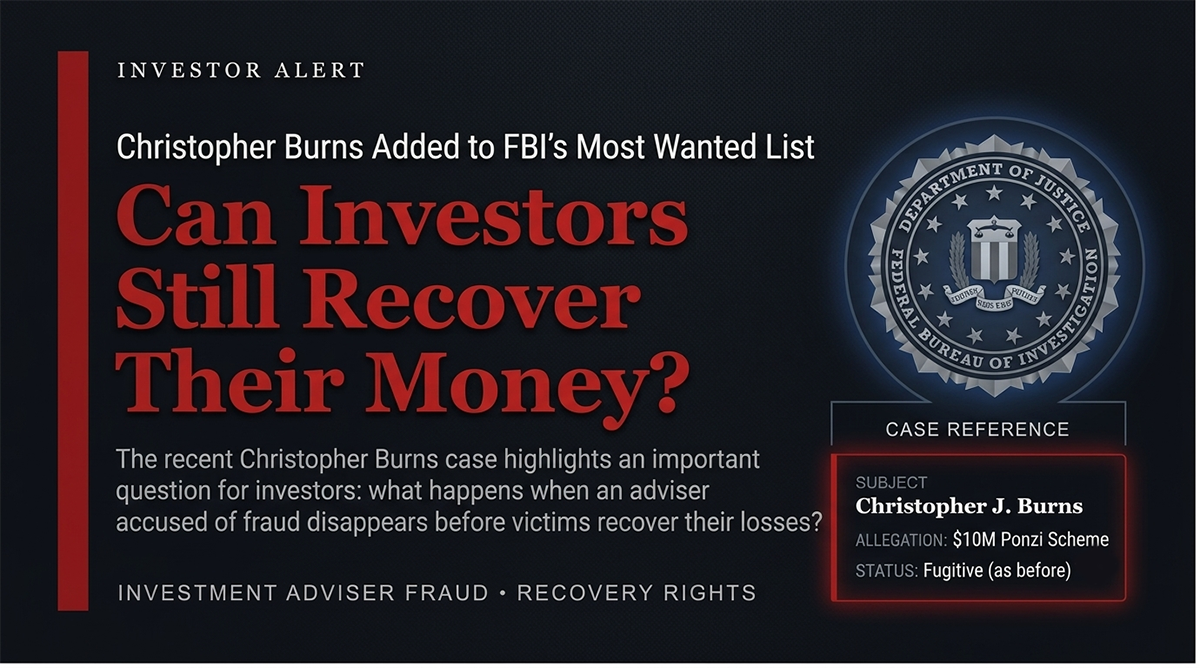
The recent Christopher Burns case highlights an important question for investors: what happens when an adviser accused of fraud disappears before victims recover their losses?
Inverted Pyramid Opening
When investors discover that the financial professional who took their money has disappeared, many assume their chances of recovery disappear as well. The recent case involving Christopher Burns, who was added to the FBI’s Most Wanted fraud fugitives list in connection with an alleged $10 million Ponzi scheme, serves as a reminder that investor recovery efforts often continue long after an accused fraudster has fled. (https://www.fbi.gov/wanted/seeking-info/christopher-j-burns)
Why This Case Matters
According to federal authorities, Burns allegedly solicited millions of dollars from investors through investment programs that promised attractive returns but were later alleged to be fraudulent. Rather than focusing solely on the allegations, the case presents an important educational opportunity for investors who may wonder what options remain available when a financial adviser becomes a fugitive. (https://www.fbi.gov/wanted/seeking-info/christopher-j-burns)
The Biggest Misconception Investors Have
One of the most common misconceptions is that once an adviser disappears, investor losses become unrecoverable.
In reality, recovery efforts often focus on far more than the individual accused of wrongdoing. Depending on the facts, investors may have rights involving:
- Brokerage firm supervision failures
- Third-party custodians
- Insurance policies
- Receivership proceedings
- Bankruptcy estates
- Assets identified through tracing efforts
- Regulatory recovery funds
In many investment fraud cases, recovery efforts continue for years after the underlying misconduct is discovered.
What Is Asset Tracing?
When a fraud is alleged, investigators often attempt to determine where investor funds were transferred and whether assets can be recovered. This process, known as asset tracing, may involve bank accounts, investment accounts, real estate holdings, business interests, vehicles, and other assets purchased with investor funds.
Even when a defendant is no longer present, asset recovery efforts may continue through civil litigation and court-appointed receivers.
What Investors Should Do
Investors who believe they may have been affected by an alleged fraud should preserve account statements, correspondence, subscription agreements, wire records, and other investment documents.
Early action can be important because recovery opportunities sometimes depend on deadlines established by courts, receivers, bankruptcy proceedings, or regulatory programs.
The Bottom Line
The Christopher Burns matter is a reminder that an adviser’s disappearance does not necessarily end the recovery process. While every situation is different, investors often have potential avenues for pursuing recovery even when the individual accused of misconduct is no longer available to answer for the allegations.
Sources
FBI Christopher Burns Most Wanted Profile
(www.fbi.gov/wanted/seeking-info/christopher-j-burns)
FBI Most Wanted Fraudsters Initiative
(www.fbi.gov/wanted/topten)
Barron’s Advisor Coverage
(https://www.barrons.com/advisor/articles/fugitive-investment-advisor-most-wanted-79ee0bcb)