

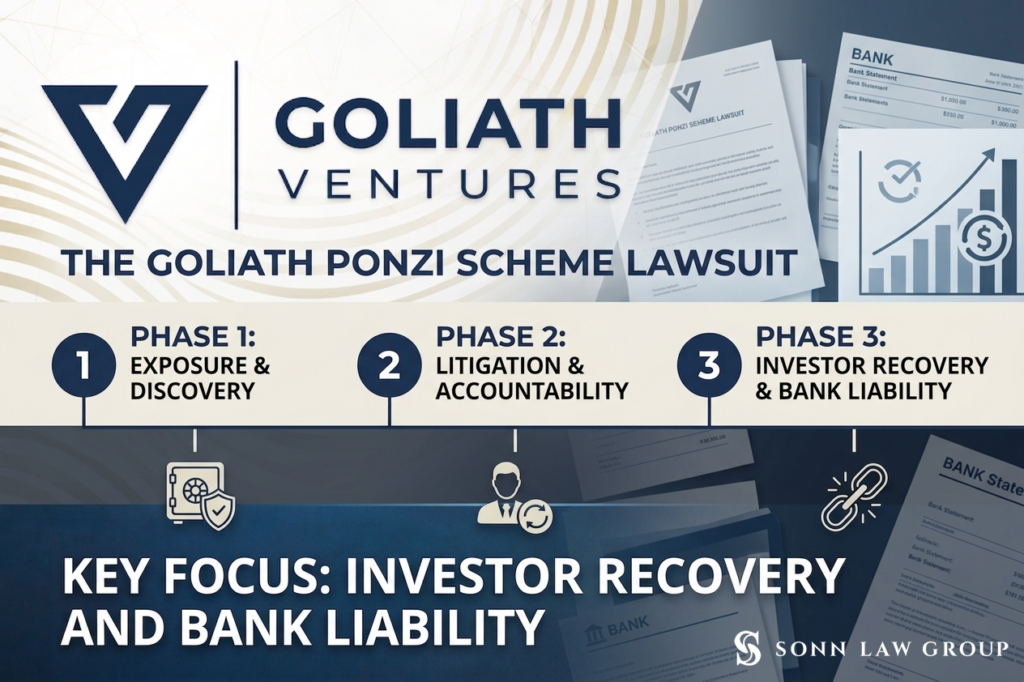
In complex financial fraud cases, events rarely unfold in a single moment. Instead, such cases progress through distinct stages, each revealing not only the facts but also the locus of accountability. The Goliath Ventures cryptocurrency scheme is currently progressing through this evolutionary process. What initially appeared as a shocking revelation of alleged misconduct has developed into a more consequential legal inquiry:
Where does meaningful recovery actually come from?
To contextualize the current status and future trajectory of this case, it is instructive to examine it through three distinct phases.
Phase I: The Illusion Shatters – Fraud Exposed
Ponzi schemes typically originate with a narrative designed to inspire confidence, urgency, and trust. In the case of Goliath Ventures, this narrative focused on cryptocurrency strategies, liquidity pools, and assurances of consistent returns within a volatile market.
As the scheme’s structure began to deteriorate, the underlying reality became quite apparent.
Federal authorities alleged that investor funds were not deployed as represented, but instead cycled through accounts to sustain the appearance of performance – the defining characteristic of a Ponzi scheme. Criminal charges followed, and early reporting detailed the scale of the alleged misconduct, including hundreds of millions raised and significant investor losses (U.S. Department of Justice).
At this stage, the primary focus is on exposure of the fraudulent activity. The central figure becomes the dominant subject of the investigation. The question is simple: What happened?
Phase II: The Legal Response — Lawsuits Filed
Once the facts begin to surface, the legal system responds. Civil litigation emerges alongside criminal proceedings, with investors seeking recovery through class actions, receivership actions, and related claims. In the Goliath matter, this includes federal litigation that expands beyond the alleged operator to examine the financial pathways through which investor funds moved.
This phase marks a critical transition: The focus expands from identifying the scheme’s creator to analyzing its operational mechanisms.
It is here that allegations involving financial institutions begin to take shape – including claims that JPMorgan Chase Bank, N.A. processed transactions tied to the scheme and failed to act on activity that plaintiffs contend should have triggered scrutiny under anti-money laundering frameworks.
Coverage of similar cases has increasingly emphasized this expansion, noting that financial institutions are under growing pressure to detect and respond to suspicious transaction patterns.
At this stage, the question evolves: Who may bear responsibility beyond the primary actors?
Phase III: The Reality Check — When the Primary Defendant Collapses
The Goliath case has now entered its most consequential phase.
Recent reporting confirms that the entity at the center of the alleged scheme has filed for bankruptcy (Orlando Sentinel). This development is not merely procedural; it is pivotal to the case’s progression.
Bankruptcy filings in large-scale fraud cases often reveal a stark imbalance between remaining assets and investor losses – a reality that can fundamentally reshape the trajectory of recovery efforts. Practically, this situation raises a new and unavoidable question:
If the primary actor cannot satisfy investor claims, where does recovery come from?
Where Recovery Turns: Beyond the Operator
This is where the lens shifts – sharply and necessarily.
In contemporary financial fraud litigation, recovery efforts rarely conclude with the collapse of the central figure. Instead, attention shifts to the broader financial ecosystem that facilitated the scheme’s operation.
That ecosystem may include:
• Banks that processed and routed investor funds
• Intermediaries who facilitated transactions or account structures
• Promoters or advisors who introduced or directed investor capital
• Financial infrastructure – including platforms and payment channels – through which funds moved
Each layer represents a potential point of legal inquiry.
A Shift in Perspective — and Strategy
What distinguishes Phase III is not just the facts, but the perspective it demands. The story is no longer about a single actor. It is about a system.
The movement of funds – across accounts, institutions, and platforms – becomes the map through which accountability is traced. Discovery efforts often focus on internal communications, transaction monitoring alerts, and compliance responses to determine whether warning signs were identified, escalated, or overlooked.
In this phase, litigation becomes more than reactive. It becomes analytical, reconstructive, and systemic.
Where the Goliath Case Stands Today
The Goliath litigation now sits at this inflection point.
With Sonn Law Group serving as lead counsel in conjunction with co-counsel, the case is advancing within a framework that reflects this broader perspective, examining both the alleged fraud and the financial pathways that enabled its expansion. This stage will likely define the ultimate trajectory of recovery.
In cases of this nature, the outcome is seldom determined by discoveries in Phase I or filings in Phase II, but rather by the effectiveness with which Phase III is navigated.
CONTACT US FOR A FREE CONSULTATION
Se Habla Español
Contact our office today to discuss your case. You can reach us by phone at 844-689-5754 or via e-mail. To send us an e-mail, simply complete and submit the online form below.