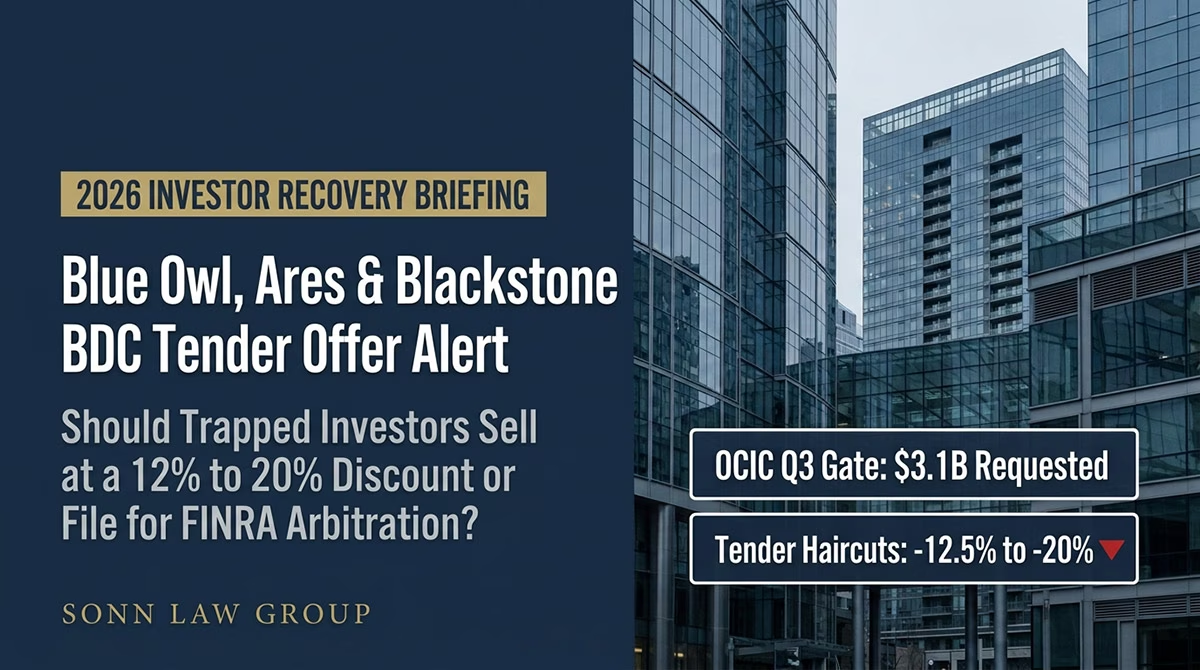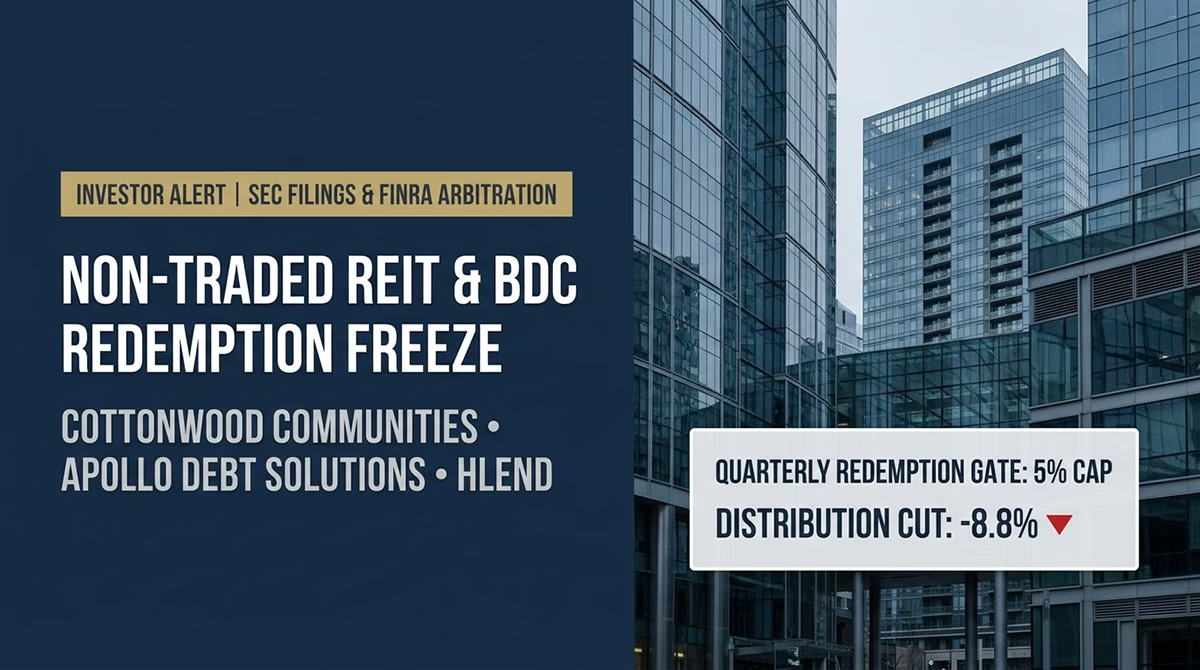
In the first two parts of our 2026 alternative investment series, we examined the distribution cuts at Cottonwood Communities and the surge in redemption gates and mini-tender offers hitting Blue Owl, Ares, and Blackstone private credit funds. While non-traded business development companies (BDCs) are the latest funds to ration withdrawals, the liquidity crisis for everyday retirees began in a closely related corner of Wall Street: institutional non-traded real estate investment trusts (REITs).
During the post-2020 era of ultra-low interest rates, brokers and wealth managers moved tens of billions of dollars from conservative retiree portfolios into “perpetual-life” non-traded REITs managed by firms like Starwood Capital, KKR, and Blackstone. Investors were told these flagship real estate funds offered the steady income of physical property without the volatility of the stock market, backed by monthly or quarterly share buyback programs.
Today, many of those same investors are finding out the hard way that a non-traded REIT is only liquid until everyone wants their money back at the same time. Here is where the major institutional non-traded REITs stand in late 2026 and how harmed investors can use FINRA arbitration to recover their capital.
1. Starwood Real Estate Income Trust (SREIT): From Tightened Caps to a Full Freeze
No fund illustrates the danger of non-traded REIT liquidity promises quite like Starwood Real Estate Income Trust, Inc. (SREIT), a roughly $9 billion commercial real estate fund heavily concentrated in multifamily apartments and industrial properties.
After higher interest rates pressured property values and drove a wave of investor exit requests, Starwood’s board steadily closed the exit doors:
- Drastic Tightening of Withdrawal Limits: Before shutting the window completely, Starwood slashed its repurchase limits from 2% of NAV per month (and 5% per quarter) down to just 0.33% of NAV per month, leaving the vast majority of quarterly redemption requests unfilled.
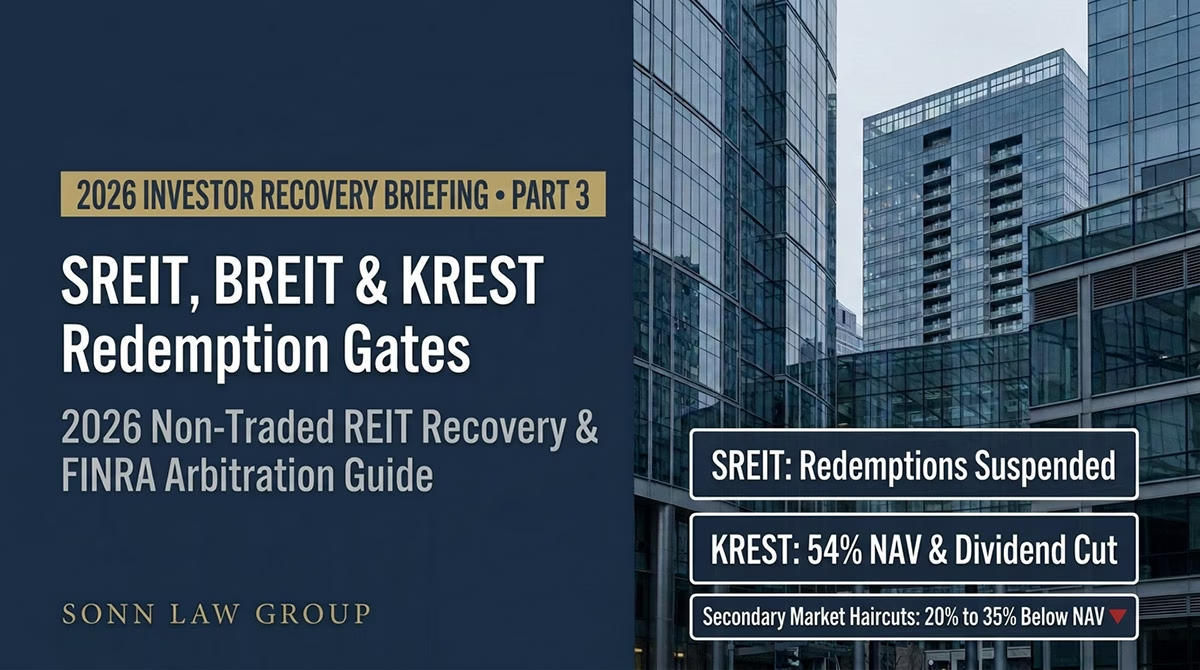
- Complete Suspension of Redemptions: On April 30, 2026, SREIT suspended its regular share repurchase program altogether and cut its annualized Class I distribution yield from roughly 6.3% to 4.7%.
- No Mandatory Reopening Date: Unlike publicly traded REITs that can be sold on the New York Stock Exchange in seconds, SEC rules do not force a non-traded REIT to reopen its buyback program on any set schedule. As a result, trapped SREIT shareholders who need immediate cash are currently seeing secondary-market liquidity buyers pitch them at steep 22% to 25% discounts below reported NAV.
2. KKR Real Estate Select Trust (KREST): Steep NAV Erosion and Distribution Cuts
Investors who were steered into KKR Real Estate Select Trust Inc. (KREST) have faced a painful combination of principal decline, reduced monthly income, and past redemption rationing.
According to public SEC filings and shareholder reports through late 2026:
- Sharp Drop in Share Value: After launching at $25.00 per share and climbing above $31.00 during the real estate peak, KREST’s stated NAV fell by more than 24% over the ensuing downturn, landing near $23.49 per share in recent 2026 filings.
- 54% Distribution Reduction: Even more damaging for retirees who relied on KREST to pay living expenses, the fund cut its monthly distribution by roughly 54%, dropping from $0.13 per share per month to $0.06 per share per month.
- Return-of-Capital Concerns: Public filings also revealed that substantial portions of KREST’s historical distributions were funded through return of capital or expense support agreements rather than pure net investment income, meaning investors were partially receiving their own money back while paying steep management and servicing fees.
3. Blackstone Real Estate Income Trust (BREIT) and the Reality of “Semi-Liquid” Funds
Even when a flagship fund manages to clear its redemption backlog, the damage done during a multi-year liquidity bottleneck often leaves retail investors far behind where they would have been in a balanced, liquid portfolio.
Blackstone Real Estate Income Trust, Inc. (BREIT) became the poster child for non-traded REIT gates when it prorated shareholder withdrawals for 16 consecutive months before finally fulfilling 100% of repurchase requests again in early 2024. While Blackstone avoided the complete shutdown currently hitting Starwood’s SREIT, BREIT only survived the run on its cash after orchestrating a massive multibillion-dollar institutional rescue deal with the University of California endowment and selling off billions in prized real estate assets.
For retail investors holding SREIT, KREST, Cottonwood Communities, or dozens of smaller non-traded REITs that lack Blackstone’s balance-sheet firepower, there is no institutional white knight waiting in the wings.
4. How Investors Recover Non-Traded REIT Losses Through FINRA Arbitration
When you open your monthly brokerage statement and see that your non-traded REIT has suspended redemptions or lost a quarter of its value, your financial advisor will almost always tell you to “be patient and wait for the real estate cycle to turn around.”
Wait-and-see advice protects the broker, not the investor. Under FINRA Rule 12206, investors have a strict six-year eligibility window from the date of purchase to bring a claim in FINRA arbitration, and state statutes of limitations can run out even sooner.
When Sonn Law Group pursues a FINRA arbitration claim against a brokerage firm over frozen or declining non-traded REITs, our case focuses on what happened the day the investment was sold to you:
- Misrepresenting “Periodic Liquidity” as Guaranteed Access: Brokers routinely pitch monthly or quarterly share repurchase plans as if they work like a money market account. Failing to warn a conservative client that the REIT’s board can cut distributions and freeze withdrawals at the exact moment real estate markets drop is a textbook violation of the SEC’s Regulation Best Interest (Reg BI).
- Stacking Multiple Illiquid Funds in One Account: We frequently examine retirement accounts where a broker placed a client into Starwood REIT, KKR Real Estate Select Trust, Cottonwood Communities, and two or three non-traded BDCs all at once. Packing an account with overlapping, high-commission alternative funds violates FINRA Rule 2111 (Suitability) and the brokerage firm’s duty to supervise under FINRA Rule 3110.
- Chasing Upfront Commissions and Trailing Fees: Unlike low-cost index funds or public REITs that trade on open exchanges, non-traded REITs often compensate brokerage firms with upfront placement loads, dealer-manager fees, and annual servicing trails that eat directly into investor returns.
Frequently Asked Questions
How can a FINRA arbitration panel calculate my damages if my REIT is frozen and hasn’t been sold?
You do not have to wait for a non-traded REIT to liquidate or sell your shares to a secondary buyer at a 25% loss before filing a claim. In FINRA arbitration, panels regularly award rescission (where the brokerage firm is ordered to take back the frozen shares and refund your original investment plus interest, minus distributions received) or award net out-of-pocket damages based on independent secondary-market pricing.
What if I signed a disclosure form acknowledging that the REIT was illiquid?
Brokerage firms always point to boilerplate risk disclosures buried in a 300-page prospectus or a one-page acknowledgment form. However, FINRA arbitrators know that retail clients rely on the verbal recommendations of their trusted advisor. Signing a standard disclosure form does not give a broker a free pass to recommend an unsuitable, overconcentrated investment to a retiree who needs safe, accessible funds.
Can investors aged 70 or older get an expedited FINRA hearing?
Yes. Under FINRA Rule 12808, which went into effect on March 30, 2026, investors who are at least 70 years old or who suffer from a serious medical condition qualify for mandatory accelerated arbitration timelines, cutting months off the recovery process.
Speak With a Non-Traded REIT Attorney at Sonn Law Group
If your financial advisor placed your retirement savings into Starwood Real Estate Income Trust (SREIT), KKR Real Estate Select Trust (KREST), Blackstone REIT (BREIT), Cottonwood Communities, or another frozen non-traded REIT or BDC, you may be entitled to recover your losses directly from the brokerage firm that sold you the investment.
Sonn Law Group represents individual and institutional investors nationwide in FINRA arbitration and securities litigation. Because we work on a contingency-fee basis, you pay no attorney fees or expenses unless we recover money for you. Contact our office today for a free, confidential consultation.