While thousands of income-seeking retirees are currently dealing with redemption freezes inside non-traded REITs and private credit BDCs, a second complex product is quietly generating massive losses inside traditional wirehouse and regional brokerage accounts: non-principal-protected “worst-of” structured notes.
Between 2022 and 2025, financial advisors across the country pitched autocallable and contingent-income structured notes to conservative clients as safe, high-yield alternatives to corporate bonds or CDs. Advisors highlighted annualized coupon yields of 8% to 12% and reassured retired clients that a 20% or 30% “downside barrier” would protect their principal.
For many investors, that pitch proved disastrous. When a single volatile stock or index inside the note’s underlying basket fell below its barrier threshold, regular interest checks stopped overnight and investors were left holding deep, permanent principal losses at maturity.
Following a wave of nine-figure arbitration awards and settlements, regulators have stepped in. Here is what FINRA’s 2026 targeted examination of worst-of structured notes reveals about Wall Street sales practices, and how harmed investors can pursue recovery through FINRA arbitration.
1. Why “Worst-Of” Structured Notes Are Built to Fail Conservative Investors
A traditional structured note is a hybrid debt security issued by a large investment bank that combines a zero-coupon bond with an embedded options contract tied to an underlying stock or market index.
A “worst-of” structured note takes that complexity a step further. Instead of linking your return to a single benchmark like the S&P 500, the issuing bank links the note to a basket of two, three, or four separate reference assets (for example, the S&P 500, the Russell 2000, and the Nasdaq-100, or three individual technology stocks).
What brokers frequently fail to explain at the point of sale is how the math actually works against the investor:
- You Do Not Get Diversification: In a normal portfolio, owning three different stocks reduces your risk because winners offset losers. In a worst-of note, the exact opposite happens. Your interest payments and the return of your original principal at maturity are tied entirely to whichever single asset performs the worst.
- The “Cliff” Barrier Trap: Many worst-of notes feature a contingent downside barrier (such as 70% of the initial level). If two stocks in the basket rise by 40%, but the third stock drops by 32% at maturity, the barrier is breached. Your downside protection vanishes completely, and your principal is slashed dollar-for-dollar with the single worst-performing stock, resulting in an immediate 32% loss of your savings.
- Heads the Bank Wins, Tails You Lose: If all three underlying assets perform well, the issuing bank typically exercises an “autocall” feature, calling the note back early and capping your upside. If one asset crashes, the note stays alive, your coupon payments can dry up, and you are locked into an illiquid loss with no active secondary market to exit the trade.
2. FINRA’s 2026 Targeted Sweep Into “Worst-Of” Note Concentrations
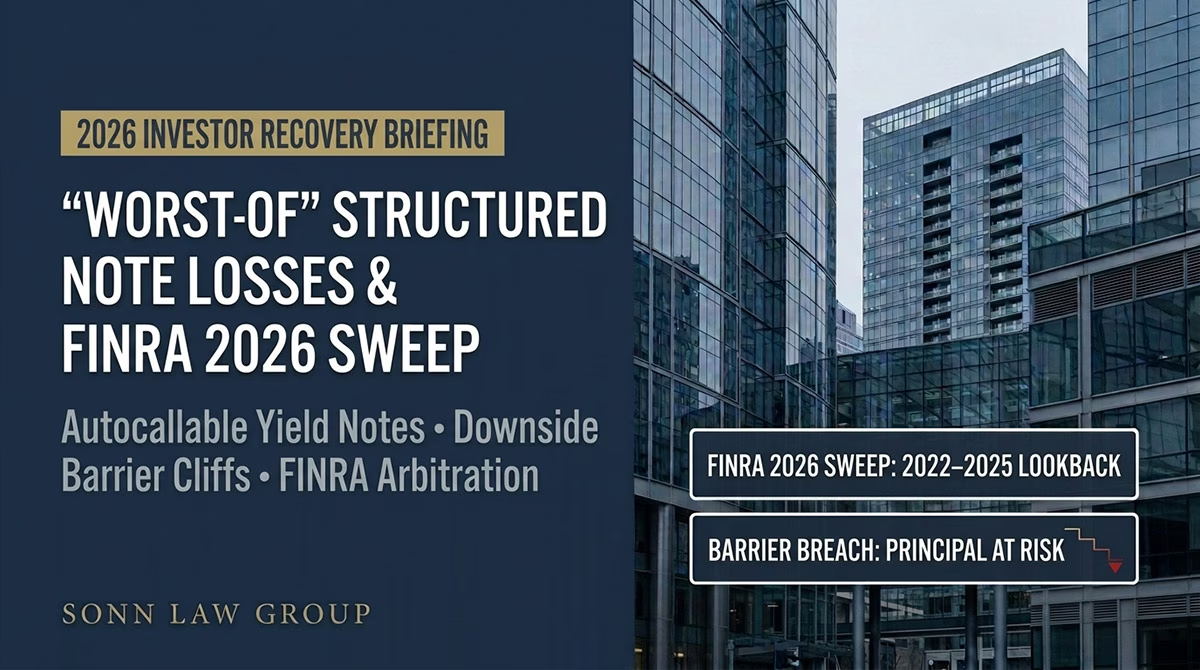
On May 19, 2026, FINRA formally announced a targeted regulatory review of higher-risk structured products, issuing an industry-wide May 2026 sweep letter on concentrations in non-principal-protected worst-of structured notes.
Covering a lookback period from January 1, 2022 through December 31, 2025, FINRA’s enforcement and examination teams ordered brokerage firms to turn over internal records showing:
- How the firm classified worst-of and non-principal-protected notes for risk and supervision purposes.
- Whether the firm enforced strict concentration limits preventing advisors from packing a large percentage of a retail customer’s liquid net worth into structured notes.
- What supervisory exception alerts triggered when a broker repeatedly rolled a customer from one structured note into the next.
- How brokers were compensated for selling structured notes and how the firm mitigated those commission conflicts under the SEC’s Regulation Best Interest (Reg BI).
In announcing the sweep, FINRA pointedly noted that its examiners had already identified multiple instances where brokers concentrated customer accounts in non-principal-protected worst-of notes, causing retail investors to lose substantial portions of their portfolios.
3. Over $200 Million in Arbitration Claims Show the Scale of the Problem
FINRA’s 2026 sweep did not happen in a vacuum. Over the past year, structured note overconcentration has produced some of the largest customer arbitration awards and claims in the country:
- The $206 Million Stifel Structured Note Fallout: Following a landmark $133 million FINRA arbitration award in March 2025 (which resolved in April 2026 after a federal magistrate recommended upholding the award), total customer claims tied to barred former Stifel, Nicolaus & Co. broker Chuck A. Roberts have topped $206 million. Investors alleged that accounts meant for conservative wealth preservation were heavily concentrated and repeatedly rolled over in high-risk structured notes that collapsed when underlying equities dropped.
- Multi-Million-Dollar Wirehouse Claims Continue in Late 2026: The problem extends far beyond a single firm. In another recent FINRA arbitration filing (Case No. 25-02627), a retired investor brought a $2 million claim against RBC Capital Markets alleging that a Naples, Florida advisor placed the client’s entire retirement portfolio into complex structured notes in violation of FINRA Rule 2111 (Suitability).
Why do brokers roll clients through dozens of structured notes year after year? Every time an autocallable note is called away after six or twelve months and the broker places the proceeds into a brand-new note, the brokerage firm collects a fresh 2% to 4% upfront underwriting fee or selling concession. What looks to the client like an active “income strategy” often functions like high-fee account churning under the hood.
4. Four Signs You Have a Viable FINRA Arbitration Claim Over Structured Notes
If you suffered losses in structured notes issued by JPMorgan, Citigroup, Barclays, Goldman Sachs, Morgan Stanley, UBS, HSBC, or Bank of Montreal, your legal claim is not against the issuing bank that created the note. Your claim is against the brokerage firm or wealth management firm that recommended and concentrated the notes in your account.
When our attorneys evaluate structured note portfolios for FINRA arbitration, we look for four clear red flags:
- Your Account Held a “Ladder” or Heavy Concentration of Notes: Even for a wealthy investor, complex derivatives should never make up the bulk of a retirement or trust account. If your advisor placed 15%, 25%, or 50%+ of your portfolio across a series of worst-of notes, the brokerage firm likely violated its supervisory duties under FINRA Rule 3110.
- You Were Told the Notes Were “Principal Protected” or “Buffer Protected”: Brokers frequently confuse or conflate a true Principal Protected Note (PPN) with a contingent barrier note. If you were told you could only lose money if the entire stock market crashed, your advisor misrepresented the product.
- Continuous Early Rollovers and Re-Invested Calls: If your monthly statements show dozens of structured note purchases over a two-to-four-year period, the layered upfront fees and embedded bank pricing drag steadily eroded your principal before the market ever turned south.
- Your Purchases Occurred Between 2022 and 2025: That exact window is the subject of FINRA’s 2026 targeted sweep. It is also a critical window under FINRA Rule 12206, which requires arbitration claims to be filed within six years of the purchase date.
Frequently Asked Questions
Can I recover losses if my structured notes are still in my account and haven’t matured yet?
Yes. Once a worst-of note’s underlying asset drops toward or below its barrier, the note’s market value on your monthly statement typically plunges well below par ($100). You do not have to wait two or three years for the note’s final maturity date to file a FINRA arbitration claim seeking recovery of your damages.
What if I have a high net worth or signed a complex-product disclosure form?
Having a multimillion-dollar net worth does not mean you wanted to gamble your retirement savings on three-stock derivative baskets. Under Regulation Best Interest, a broker cannot cure an unsuitable, overconcentrated recommendation simply by having a client initial a standard disclosure form.
Do investors over age 70 qualify for faster FINRA arbitration hearings?
Yes. Under FINRA Rule 12808, which took effect on March 30, 2026, claimants who are 70 or older or who are facing a serious health condition are entitled to mandatory accelerated timelines throughout the arbitration process.
Speak With a Structured Note Recovery Attorney at Sonn Law Group
If your financial advisor concentrated your portfolio in non-principal-protected “worst-of” structured notes, autocallable yield notes, or other complex derivative products without clearly explaining the downside risks, you may have a strong claim to recover your losses.
Sonn Law Group represents individual and institutional investors nationwide in FINRA arbitration against major wirehouses and independent brokerage firms. We handle all cases on a contingency-fee basis, meaning you pay no attorney fees unless we recover compensation for you. Contact our office today for a free, confidential review of your account statements.