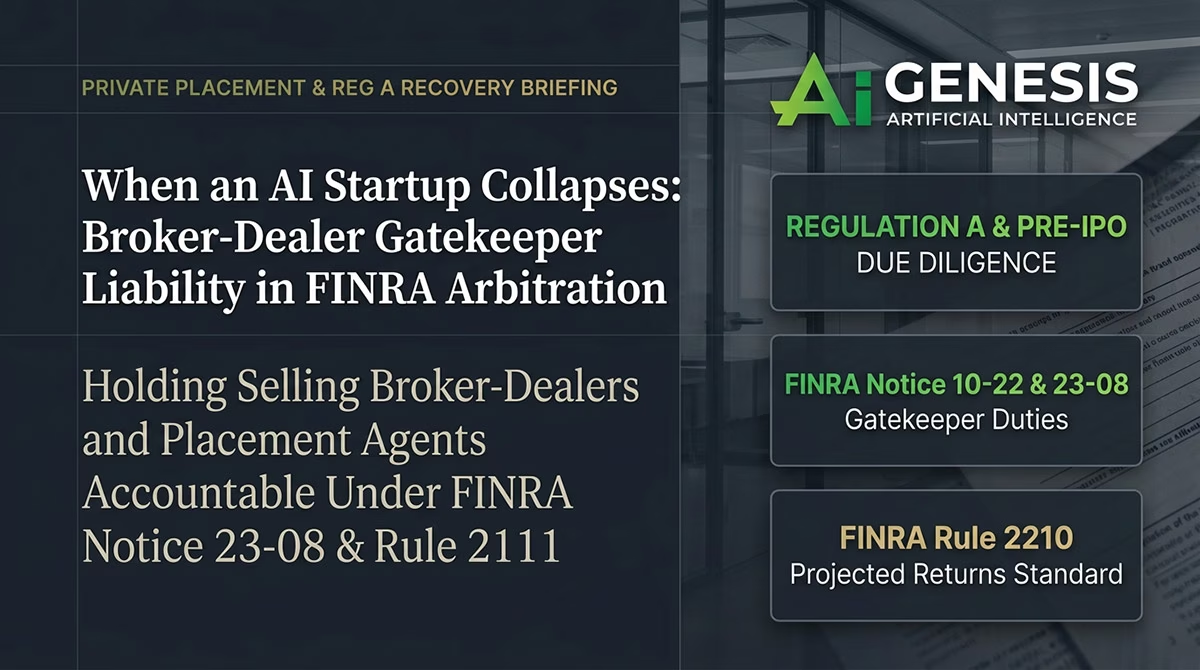
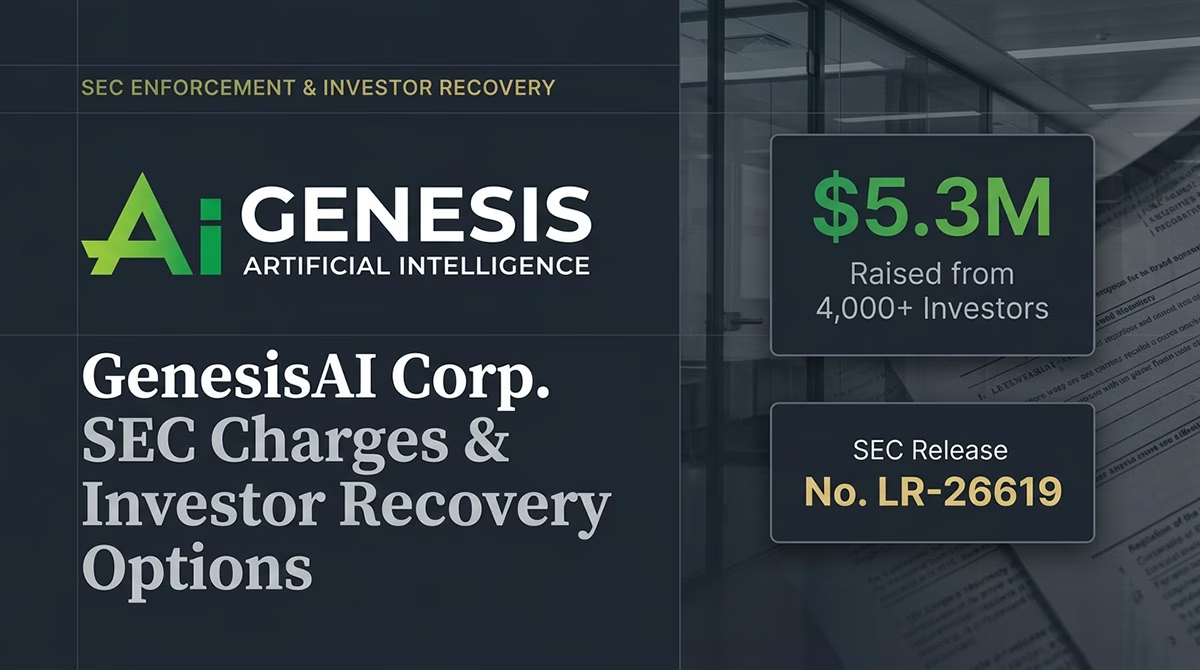
More than 4,000 retail investors who poured over $5.3 million into artificial intelligence startup GenesisAI Corp. are currently asking the same question: How can a company raise millions on the back of a $204 million valuation, shut down its software development, and walk away from an SEC enforcement action by paying just $109,184?
In SEC Litigation Release No. 26619, filed in the U.S. District Court for the Southern District of Florida (SEC v. GenesisAI Corp. and Archil Cheishvili, Case No. 1:26-cv-25837-RKA), federal regulators charged the formerly Miami-based company and its founder and former CEO, Archil Cheishvili, with negligently misrepresenting the company’s revenue projections, corporate valuation, and customer demand across multiple Regulation Crowdfunding (Reg CF) and Regulation A offerings between December 2019 and December 2024.
While other legal blogs have simply summarized the SEC’s short press release, a closer look at the actual 15-page federal complaint and GenesisAI’s SEC EDGAR filings reveals critical details about how these shares were sold, which intermediaries and broker-dealers were involved, and when harmed investors can pursue recovery through FINRA arbitration.
1. Inside the SEC Complaint: A $204 Million Valuation Built on Near-Zero Marketplace Revenue
GenesisAI pitched itself to everyday investors as the “Amazon for AI services,” claiming it was building a machine-learning marketplace where businesses could buy, sell, and link artificial intelligence models. Using social media ads, YouTube videos, mass email blasts, and even sidewalk display ads, Cheishvili and GenesisAI raised more than $5.3 million from retail investors.
According to the SEC’s federal complaint, the numbers used to sell those shares did not match reality:
- Unfounded $250 Million Revenue Projections: Beginning in December 2019, GenesisAI circulated investor slide decks projecting that annual revenue would climb from zero in mid-2020 to $250 million by 2024. In reality, the AI marketplace stayed in beta testing until May 2022, never became commercially viable, and generated virtually no revenue. By 2024, what little revenue GenesisAI brought in came mostly from an internal mass-email server tool the company built to blast solicitations to prospective investors.
- Subjective Valuations Ratcheted From $7.5M to $204M: Despite producing no meaningful revenue and holding no major assets beyond investor cash, Cheishvili steadily hiked GenesisAI’s stated valuation in each fundraising round. The company went from a $7.5 million implied valuation in late 2019 to $47 million in April 2021, $89 million in September 2021, and $204 million in its July 2022 offering. The SEC alleged those valuations were based purely on Cheishvili’s subjective estimates.
- Non-Existent Customer Waitlists and Unenforceable “Partnerships”: GenesisAI told prospective buyers that it had up to 25 corporate partnerships and an active customer waitlist. Regulators found that the claimed partnerships were not enforceable agreements and that no actual customer waitlist existed.
2. How the Shares Were Sold: Wefunder, Netcapital, StartEngine, and Broker-Dealer Dalmore Group
One of the most important facts buried inside Paragraph 23 of the SEC’s complaint is the exact timeline of the platforms and registered entities used to raise money from the public:
- Four Crowdfunding Campaigns (Wefunder and Netcapital): Starting in December 2019, GenesisAI ran an initial Regulation Crowdfunding campaign offering Simple Agreements for Future Equity (SAFEs) through Wefunder Portal LLC, followed by three separate crowdfunding campaigns through Netcapital Funding Portal Inc. (whose own executives faced separate SEC charges in August 2026 over alleged sham consulting transactions).
- A Cancelled StartEngine Offering: In September 2021, GenesisAI launched another crowdfunding round through StartEngine Primary LLC, which StartEngine subsequently cancelled.
- The 2022 Regulation A Offering Through Registered Broker-Dealer Dalmore Group, LLC: In 2022, GenesisAI qualified a Tier 2 Regulation A stock offering (priced at $4.25 per share) engaging Dalmore Group, LLC, a FINRA-registered broker-dealer, as broker-dealer of record to perform administrative, compliance, and technology functions in exchange for a 1% commission plus consulting and expense fees.
- Founder Cash-Out During the 2022 Reg A Offering: Crucially, the 2022 Regulation A offering permitted Cheishvili to sell a portion of his personal GenesisAI shares directly to investors. Between February 2022 and June 2022, while the company was touting a $200M+ valuation, Cheishvili sold 12,000 of his own shares for approximately $51,000 in personal profit.
3. Why the SEC Settlement Won’t Make GenesisAI Investors Whole
On January 2, 2025, GenesisAI filed a Form 1-U report with the SEC announcing that Cheishvili had resigned from all positions and that the board had voted to suspend all software and AI marketplace development, cancelling its Amazon Web Services (AWS) and Google Cloud hosting accounts to conserve whatever cash remained.
When the SEC announced its settled charges under Section 17(a)(2) of the Securities Act on August 26, 2026 (with the federal court entering final judgment on September 14, 2026), both GenesisAI and Cheishvili consented to permanent injunctions without admitting or denying the allegations. Financially, Cheishvili was ordered to pay:
- $50,000 in disgorgement (matching the roughly $51,000 he pocketed selling his personal shares in the 2022 Reg A offering)
- $9,184.53 in prejudgment interest
- A $50,000 civil penalty
For more than 4,000 investors who collectively lost $5.3 million, a $109,184 SEC recovery represents roughly two cents on the dollar. Just as we explain in our guide on filing a FINRA complaint versus a FINRA arbitration claim, regulatory enforcement actions are designed to punish rulebreakers and deter misconduct, not to fully reimburse individual investors for their portfolio losses.
4. How Harmed AI & Pre-IPO Investors Can Pursue Recovery Through FINRA Arbitration
When an early-stage startup like GenesisAI halts product development and drains its bank accounts, suing the shell company itself rarely recovers meaningful money. Instead, experienced securities litigation attorneys look at the licensed financial intermediaries, registered broker-dealers, and investment advisors who recommended, marketed, or facilitated the transaction.
Across the country in late 2026, retail investors are facing heavy losses from a wave of hyped AI and pre-IPO private placements, ranging from Reg A startups like GenesisAI to the massive $450 million federal criminal fraud indictment against Linqto founder William Sarris, where thousands of investors were sold heavily marked-up private shares in companies like Ripple and SpaceX without proper disclosures.
Under FINRA Regulatory Notice 10-22, FINRA Regulatory Notice 23-08, and the SEC’s Regulation Best Interest (Reg BI), registered broker-dealers and financial advisors have an independent legal duty to conduct a “reasonable investigation” into an issuer’s financial claims before selling or recommending private or exempt securities to the public.
You may have an actionable recovery claim if:
- A Financial Advisor or Broker Recommended the Investment: If a licensed broker or wealth manager steered you into GenesisAI, a pre-IPO fund, or a series of high-risk Regulation A / Regulation D private placements that did not match your risk tolerance, the brokerage firm can be held liable in FINRA arbitration under FINRA Rule 2111 (Suitability) and FINRA Rule 3110 (Supervision).
- A Registered Broker-Dealer Failed in Its Gatekeeper Duties: When FINRA-member broker-dealers act as placement agents or broker-dealers of record on Regulation A and private placement offerings, they cannot blindly rubber-stamp a founder’s $250 million revenue forecast when a basic review of the company’s books would show the product is still in beta testing with zero commercial traction.
Frequently Asked Questions
Will the SEC’s $109,184 settlement with Archil Cheishvili be refunded to GenesisAI shareholders?
Even if the SEC distributes the $50,000 disgorgement and $50,000 penalty through a Fair Fund, dividing roughly $109,000 among more than 4,000 harmed investors equals less than $28 per investor. Investors who suffered substantial five- or six-figure losses in GenesisAI or similar Reg A / pre-IPO offerings must look to private securities litigation or FINRA arbitration against solvent third parties to pursue meaningful recovery.
Is GenesisAI Corp. still operating its AI marketplace in 2026?
In a Form 1-U filed with the SEC on January 2, 2025, GenesisAI disclosed that Archil Cheishvili resigned as CEO and that the Board of Directors voted to suspend all product development for its AI marketplace and email automation tools, cancelling its cloud hosting services to reduce expenses.
What is the deadline to file a FINRA arbitration claim for an unsuitable Regulation A or private placement investment?
Under FINRA Rule 12206, claims must be filed within six years of the purchase date, and state securities statutes of limitations can be considerably shorter. In addition, investors aged 70 or older or facing serious health issues now qualify for mandatory expedited arbitration schedules under FINRA Rule 12808.
Speak With a Securities Fraud Attorney at Sonn Law Group
If you suffered substantial investment losses in GenesisAI Corp., a Regulation A or Regulation D private placement, or an unapproved pre-IPO offering recommended or facilitated by a financial advisor or registered brokerage firm, our legal team can help you evaluate your options.
Sonn Law Group represents defrauded investors nationwide in FINRA arbitration and securities litigation on a contingency-fee basis, meaning you pay no legal fees unless we recover money for you. Contact our office today for a free, confidential consultation.