Across the United States in late 2026, families are facing an epidemic of catastrophic retirement losses caused by third-party financial scams. Using sophisticated government impersonation schemes, tech-support pop-ups, and “pig butchering” cryptocurrency frauds, overseas criminal syndicates convince law-abiding retirees to liquidate lifelong IRA and brokerage accounts and wire hundreds of thousands of dollars to outside banks or crypto exchanges.
When the victim or their adult children discover the fraud and call the brokerage firm, they almost always receive the same cold response from the compliance department: “Your parent logged in, verified their identity, and authorized the wire transfers themselves. Because the customer gave the instruction, the firm has zero responsibility for the loss.”
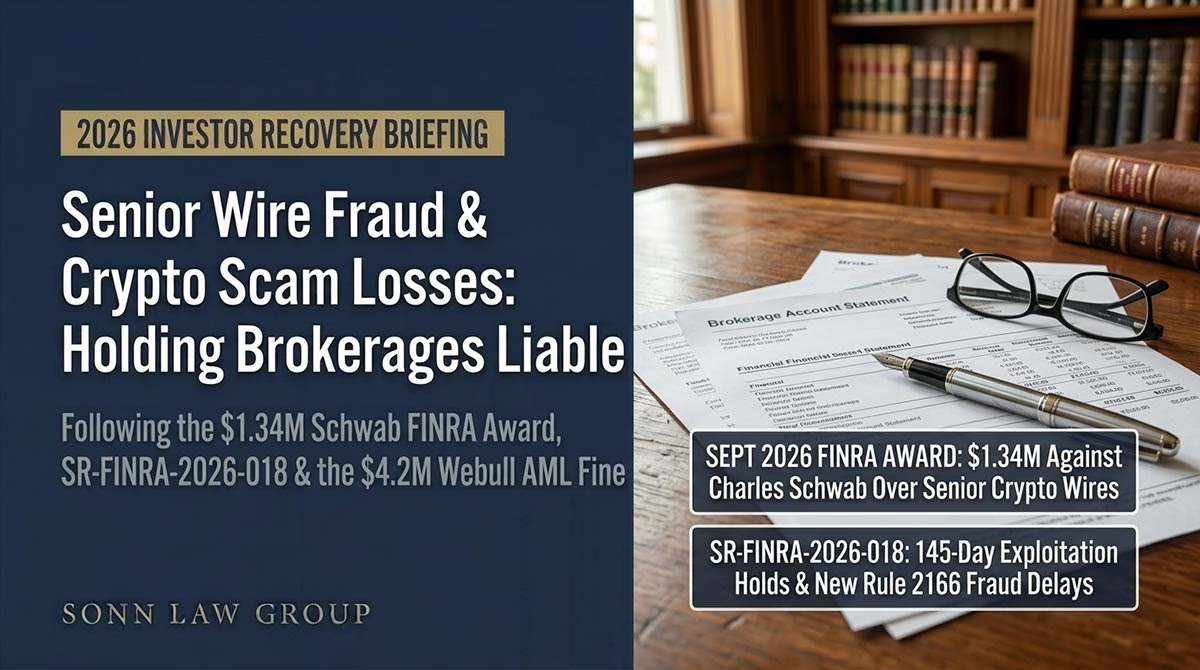
For years, that defense worked. Today, it is crumbling. Between a landmark $1.34 million FINRA arbitration award against Charles Schwab, FINRA’s sweeping new SR-FINRA-2026-018 senior protection rules, and a $4.2 million regulatory fine against Webull Financial on November 5, 2026, securities arbitrators and regulators are sending a clear message: a brokerage firm cannot ignore glaring fraud alarms inside its own computer systems and simply wave an elderly client’s life savings out the door.
Here is how the legal landscape has shifted in late 2026 and when defrauded investors and their families can pursue recovery directly from a brokerage firm through FINRA arbitration.
1. The Game-Changer: A $1.34 Million FINRA Arbitration Award Against Charles Schwab
In September 2026, a three-person FINRA arbitration panel in Denver issued a groundbreaking decision in Richards v. Charles Schwab & Co., Inc. (FINRA Case No. 23-03578) that every family dealing with senior financial exploitation should read closely.
The claimants were a married couple in their 70s who had kept their retirement accounts at Charles Schwab for decades with a history of conservative, predictable investing. In the fall of 2022, one of the spouses was targeted by a relentless computer pop-up and impersonation scam. Over a six-week period, scammers manipulated the retiree into liquidating their retirement holdings and initiating a rapid series of five- and six-figure wire transfers to cryptocurrency platforms, draining $840,000 from the couple’s accounts and triggering painful IRA tax penalties.
Schwab argued that it was not responsible because the customer personally initiated the transfers and was tricked into giving the scammers fake cover stories when bank representatives asked questions.
The FINRA arbitration panel rejected Schwab’s defense and awarded the couple nearly $1.34 million, consisting of:
- $840,000 in full compensatory damages (100% of the stolen principal)
- More than $222,000 in statutory interest
- $276,000 in attorneys’ fees and costs under Colorado’s civil theft and consumer protection statutes
Why did the panel hold the brokerage firm liable for an external scam? Because the evidence showed that Schwab’s own automated fraud-monitoring software repeatedly flagged the sudden liquidations and uncharacteristic crypto-linked wires as high-risk senior exploitation, yet the firm’s personnel lifted the restrictions and processed the wires without conducting a meaningful investigation or contacting the couple’s trusted family emergency contact.
2. How FINRA Rules 2165, 4512, and 3310 Establish Brokerage Firm Duty
Brokerage firms love to pretend that once a client switches to a self-directed account or enters a two-factor security code, the firm is nothing more than a vending machine that must dispense cash on command.
Federal anti-money laundering (AML) statutes and FINRA’s rulebook establish the exact opposite. Brokerage firms are required by law to maintain continuous automated surveillance over outgoing money movements and step in when suspicious patterns emerge:
- Trusted Contact Requirements (FINRA Rule 4512): Whenever a retail customer opens or updates an account, the brokerage firm is required to make reasonable efforts to obtain the name and contact information of a “Trusted Contact Person” specifically so the firm has someone to call when it spots signs of cognitive decline, uncharacteristic wire requests, or financial exploitation.
- Senior Exploitation Disbursement Holds (FINRA Rule 2165): Enacted to protect investors aged 65 and older (and adults with mental or physical impairments), Rule 2165 empowers brokerage firms to place an immediate temporary hold on suspicious disbursements or securities transactions while the firm investigates potential exploitation and notifies the customer’s Trusted Contact.
- Mandatory AML Red-Flag Surveillance (FINRA Rule 3310): Under the Bank Secrecy Act and FINRA Rule 3310, every broker-dealer must monitor customer accounts for suspicious money movement red flags. As detailed in FINRA Regulatory Notice 19-18, when a lifelong buy-and-hold retiree suddenly sells off an entire IRA over a matter of days, incurs massive tax consequences, and wires the proceeds to an offshore bank or cryptocurrency exchange, the firm has an affirmative duty to investigate those red flags.
3. Two Major Late-2026 Regulatory Actions Reinforce Firm Accountability
Two regulatory developments over the past six weeks have given defrauded investors even stronger leverage in FINRA arbitration:
1. FINRA’s Proposed 145-Day Senior Holds and New Rule 2166 (SR-FINRA-2026-018)
In late September 2026, the SEC published Release No. 34-106275 (File No. SR-FINRA-2026-018), unveiling FINRA’s major expansion of its customer fraud protection rules. First, the proposal amends Rule 2165 to allow brokerage firms to hold suspicious senior disbursements for up to 145 business days (nearly seven calendar months) when working with state regulators or law enforcement. Second, it creates brand-new FINRA Rule 2166 (“Temporary Hold on Suspected Fraud”), which authorizes broker-dealers to pause suspicious outgoing transfers for any customer of any age when the firm reasonably suspects the client is being defrauded by a third party.
2. FINRA’s November 5, 2026 $4.2 Million Fine Against Webull Financial
On November 5, 2026, FINRA announced a $4.2 million fine against Webull Financial LLC for sweeping AML and supervisory failures between 2021 and 2024. Regulators found that Webull onboarded more than 120,000 accounts without reasonably verifying customer identities, including over 2,200 accounts opened using stolen identities of American citizens. Even worse, when a third-party fraud detection vendor warned Webull about potentially fraudulent ACATS and ACH money transfers, the firm failed to investigate until victims had already lost roughly $750,000 in unauthorized transfers.
4. Five Red Flags That Turn a Scam Loss Into a Viable FINRA Arbitration Claim
To be clear, a brokerage firm is not an automatic insurer against every internet scam. If an investor loses $15,000 in a single wire transfer that looks completely normal compared to their past account activity, holding the brokerage firm liable is difficult.
However, when our attorneys investigate six- and seven-figure scam losses at major firms like Charles Schwab, Fidelity, Morgan Stanley, Wells Fargo, UBS, Merrill Lynch, or Vanguard, we look for five specific supervisory breakdowns that support a strong FINRA arbitration claim:
- Extreme Departure From Decades of Account History: A 72-year-old retiree who has never bought cryptocurrency or wired more than $5,000 in 20 years suddenly initiates five wire transfers of $150,000 each over three weeks to a digital asset exchange or foreign bank.
- Internal Fraud Alerts Were Triggered and Overridden: In almost every major case, discovery reveals that the brokerage firm’s computer software actually halted or flagged the wire for possible elder abuse, but a hurried back-office representative cleared the hold after a superficial two-minute phone call.
- Failure to Call the Designated Trusted Contact: The customer named an adult son or daughter on their FINRA Rule 4512 Trusted Contact form, yet the firm watched the customer liquidate $1 million in retirement savings without ever picking up the phone to alert the family.
- Sudden IRA Liquidations With Massive Tax Penalties: When a senior liquidates tax-deferred retirement accounts all at once, triggering a 30%+ federal and state income tax hit with no financial planning justification, any reasonable supervisor knows something is wrong.
- Signs of Coaching or Duress on Recorded Phone Calls: Scammers routinely stay on a three-way call or coach elderly victims on what to say to bank compliance officers. Brokerage staff trained in senior exploitation are supposed to recognize scripted answers, hesitation, and coaching on recorded verification lines.
Frequently Asked Questions
Can my family bring a FINRA arbitration claim if my parent personally authorized the wire transfers?
Yes. As the September 2026 $1.34 million arbitration award against Charles Schwab demonstrates, the fact that an elderly or vulnerable investor was psychologically manipulated into authorizing a wire transfer does not absolve the brokerage firm of liability if the firm ignored its own internal fraud alerts, failed to contact a listed Trusted Contact, or breached its supervisory duties under FINRA Rules 3110 and 3310.
How do we find out if the brokerage firm’s computer system flagged the fraudulent wires?
Brokerage firms will never voluntarily admit that their internal surveillance system flagged your parent’s transfers before the money left the bank. However, once your attorney files a Statement of Claim in FINRA arbitration, the firm is legally required during discovery to hand over its internal compliance logs, fraud exception reports, back-office chat messages, and recorded phone calls relating to the account.
How fast can an elderly scam victim get a hearing in FINRA arbitration?
Under FINRA Rule 12808, which became mandatory on March 30, 2026, any claimant who is 70 years of age or older, or who suffers from a serious medical condition, is entitled to an accelerated arbitration schedule with significantly shortened deadlines for document discovery and final evidentiary hearings.
Speak With a Senior Investor Protection Attorney at Sonn Law Group
If you or an elderly family member lost a substantial portion of your retirement savings after a brokerage firm processed uncharacteristic wire transfers, ACH withdrawals, or account liquidations tied to a third-party financial scam, do not accept the brokerage firm’s claim that nothing can be done.
Sonn Law Group represents defrauded investors and families nationwide in FINRA arbitration and securities litigation. We handle cases on a contingency-fee basis, meaning you pay no attorney fees or expenses unless we recover money on your behalf. Contact our office today for a free, confidential review of your case.