For thousands of retired real estate owners and high-net-worth investors across the country, the February 2026 Chapter 11 bankruptcy of Scottsdale, Arizona private equity sponsor Inspired Healthcare Capital, LLC (IHC) turned what was pitched as a tax-advantaged retirement income stream into a financial nightmare.
Before halting investor distributions in July 2025 amid an SEC regulatory review and filing for Chapter 11 protection in the U.S. Bankruptcy Court for the Northern District of Texas (Case No. 26-90004) with $1 billion to $10 billion in reported liabilities, Inspired Healthcare Capital raised more than $1.4 billion from retail investors. The vast majority of that money was funneled into high-commission senior living Delaware Statutory Trusts (DSTs) used for 1031 real estate exchanges and private placement income funds.
Now, a critical procedural date is arriving in the litigation: November 21, 2026, the expiration date of a controversial temporary bankruptcy stay that paused more than 100 pending FINRA arbitration claims against the brokerage firms that sold IHC offerings. Here is what every Inspired Healthcare Capital and DST investor needs to know about the bankruptcy bottleneck, the broker-dealers that earned over $100 million in commissions selling these products, and how to protect your right to recover losses through FINRA arbitration.
1. Why Waiting on the Inspired Healthcare Capital Bankruptcy Estate Is a Trap for Retail Investors
When a real estate sponsor like Inspired Healthcare Capital files for Chapter 11 reorganization, many investors assume that the bankruptcy court will eventually sell off the senior living properties and return their principal.
In practice, retail equity holders and DST beneficial owners sit near the very back of the line in bankruptcy court, behind secured bank lenders, restructuring lawyers, and administrative creditors. Even worse, IHC’s collapse was preceded by severe operational distress:
- Abrupt Halt to Monthly Distributions: In July 2025, IHC stopped paying distributions across its funds and DSTs while shutting down its internal operating arm, Volante Senior Living, and disclosing an active SEC review.
- Allegations of Concealed Financial Distress: By September 2025, even an entity affiliated with IHC’s own managing broker-dealer, Emerson Equity LLC, filed a lawsuit alleging that IHC and its former CEO, Luke Lee, misrepresented the company’s financial condition and concealed severe financial distress to obtain a $1.5 million loan.
While the bankrupt sponsor has very little left for retail investors, the FINRA-registered brokerage firms that recommended and sold IHC’s products collected more than $100 million in selling commissions and fees. Those brokerage firms are solvent, insured, and outside of bankruptcy protection.
2. What the November 21, 2026 Bankruptcy Injunction Date Means for Your FINRA Claim
After IHC filed for Chapter 11 protection in February 2026, harmed investors immediately began filing FINRA arbitration claims not against the bankrupt company, but against the independent broker-dealers that sold the unsuitable investments.
In late July 2026, IHC and its restructuring team took an aggressive legal step in the Northern District of Texas adversary proceeding (Inspired Healthcare Capital Holdings, LLC v. Aurora Securities, et al.), asking Bankruptcy Judge Mark X. Mullin to temporarily freeze FINRA arbitrations against the selling broker-dealers. On July 24, 2026 (and later reaffirmed in a September 16, 2026 order), the bankruptcy court entered a preliminary injunction temporarily staying IHC-specific FINRA arbitration claims through November 21, 2026.
Two points about that order are critical for investors right now:
- Unrelated Claims Against the Same Broker-Dealers Were Never Frozen: As Judge Mullin pointed out in his September 16, 2026 ruling, the temporary stay applied only to claims tied directly to the purchase of IHC’s own funds and DSTs. Investors whose brokers packed their accounts with other defective DSTs, non-traded REITs, or private placements alongside IHC have been free to pursue those non-IHC claims all along.
- Preparing Before the Stay Window Closes: Temporary bankruptcy stays do not erase a brokerage firm’s independent liability under federal securities laws, nor do they permanently shield solvent broker-dealers from answering for their own due diligence failures in FINRA arbitration. As the November 21, 2026 deadline arrives, investors who have not yet had their portfolios audited by securities litigation counsel should act immediately so their claims are prepared and filed in line with FINRA Rule 12206 eligibility deadlines.
3. Which Brokerage Firms Sold Inspired Healthcare Capital DSTs and Private Placements?
Inspired Healthcare Capital did not sell $1.4 billion of opaque senior-housing private placements by itself. It relied on an army of independent broker-dealers and registered representatives incentivized by 6% to 10% upfront commissions and placement fees.
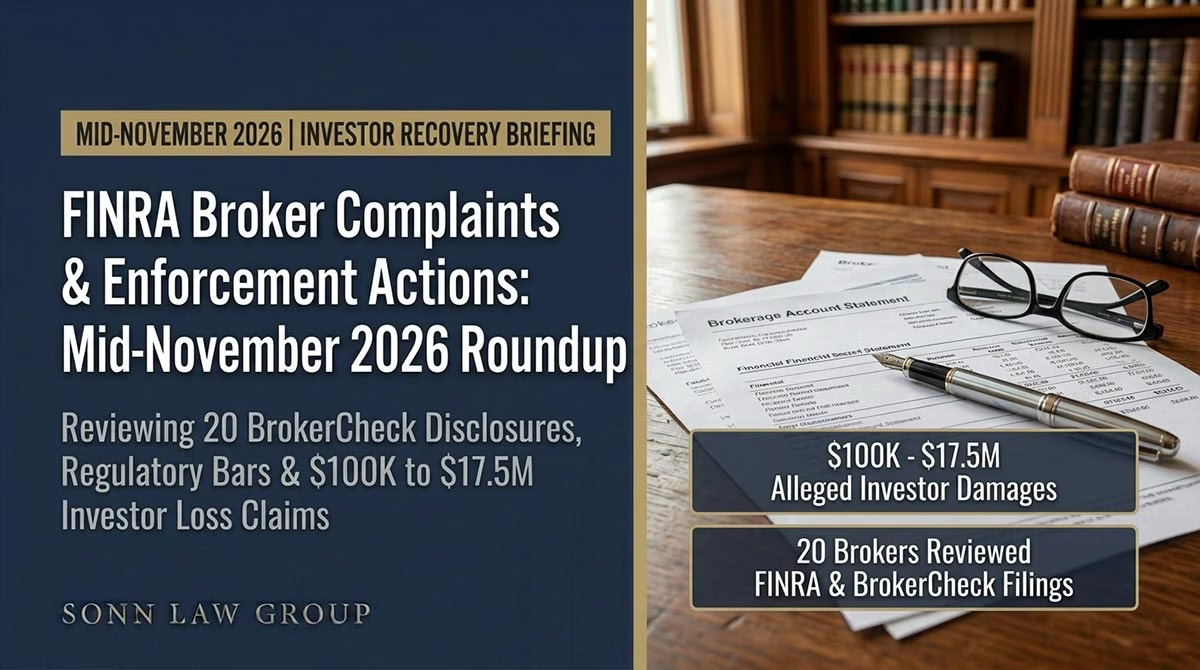
Public court filings, SEC disclosures, and recent entries in our Mid-November 2026 FINRA Broker Complaints Roundup highlight the wide network of brokerage firms connected to IHC and similar high-risk DST sales:
- Emerson Equity LLC (which served as the managing broker-dealer for many IHC offerings and was ordered by the bankruptcy court in April 2026 to turn over internal offering documents)
- Realized Financial, Inc. (named in multiple pending 2026 $500,000+ DST and private placement arbitrations, including claims involving Austin broker Jacob Adams where the underlying real estate management company filed for bankruptcy)
- Arkadios Capital (facing multiple multi-million-dollar late-2026 BrokerCheck customer disputes over DSTs and private placements, including $3 million and $2 million claims)
- DFPG Investments, LLC (named in a pending $8.5 million September 2026 FINRA arbitration over direct participation programs and alternative investments)
- Centaurus Financial, Inc., Aurora Securities, Concorde Investment Services, Newbridge Securities Corp., Berthel Fisher & Company, Ni Advisors, TCFG Wealth Management, 1031 Securities, Great Point Capital, and McDermott Investment Services
4. How Brokers Misused 1031 Exchanges and Violated FINRA Notice 23-08
Why are brokerage firms so vulnerable in FINRA arbitration over Inspired Healthcare Capital and other failed Delaware Statutory Trusts?
Many victims were retired landlords who sold a paid-off rental house, apartment building, or commercial property and wanted to defer capital gains taxes through an IRS Section 1031 exchange. Instead of advising the client that paying a modest long-term capital gains tax and investing the remaining cash in a safe, liquid portfolio of Treasury bonds and blue-chip stocks was in their best interest, brokers steered 100% of the sale proceeds into illiquid, heavily leveraged DSTs.
Under the SEC’s Regulation Best Interest (Reg BI), FINRA Rule 2111 (Suitability), and FINRA Regulatory Notice 23-08, brokerage firms had three strict duties they routinely violated:
- Letting the “Tax Tail Wag the Investment Dog”: Saving 15% or 20% on capital gains taxes makes no financial sense if the broker puts 100% of your proceeds into an opaque, high-commission senior living syndicate that goes bankrupt and wipes out your principal.
- Failure to Conduct Independent Due Diligence: Under FINRA Notice 23-08, a selling broker-dealer cannot blindly trust a sponsor’s marketing brochure. A basic forensic review of IHC’s senior housing properties and cash flows prior to 2025 would have revealed that many properties were not generating enough net operating income to cover their promised distributions without relying on new investor inflows.
- 66% Surge in Regulator Scrutiny of Broker-Dealers: On November 10, 2026, the SEC and the North American Securities Administrators Association (NASAA) released their annual enforcement data showing that regulatory actions naming broker-dealers jumped 66% over the past year as regulators cracked down on gatekeeper failures, Ponzi-like offering structures, and unsuitable retail alternative sales.
Frequently Asked Questions
Can I file a FINRA arbitration claim against my brokerage firm while Inspired Healthcare Capital is in Chapter 11 bankruptcy?
Yes, your claim for unsuitable investment advice and failure to conduct due diligence is against the solvent FINRA-member brokerage firm that sold you the investment, not the bankrupt sponsor itself. With the bankruptcy court’s temporary injunction window set through November 21, 2026 (and with non-IHC claims in bundled accounts already permitted to proceed), investors should have their accounts reviewed immediately so their FINRA Statement of Claim is positioned to move forward without delay.
What if I signed a 1031 exchange accredited investor form stating that I understood DST risks?
Every DST sponsor requires buyers to sign boilerplate risk acknowledgments. In FINRA arbitration, panels look past standard fine print to examine whether the recommendation was actually suitable for your age, net worth, and income needs, and whether the brokerage firm conducted the independent investigation required by FINRA Regulatory Notice 23-08 before placing the product on its platform.
Do senior DST investors qualify for mandatory expedited FINRA arbitration hearings?
Yes. Because 1031 exchange DSTs were disproportionately pitched to older retirees downsizing out of active property management, many IHC claimants are in their 70s or 80s. Under FINRA Rule 12808, which became mandatory on March 30, 2026, any claimant who is at least 70 years old or who certifies a serious health condition is entitled to an accelerated arbitration schedule.
Speak With an Inspired Healthcare Capital & DST Recovery Attorney at Sonn Law Group
If your financial advisor placed your 1031 exchange proceeds or retirement savings into Inspired Healthcare Capital (IHC) Delaware Statutory Trusts, IHC private placement funds, or other illiquid real estate syndications that have halted distributions, do not wait on the bankruptcy court to protect your financial future.
Sonn Law Group represents individual and institutional investors nationwide in FINRA arbitration against the brokerage firms and wealth managers that improperly sold high-commission DSTs and alternative investments. We work on a contingency-fee basis, meaning you pay no attorney fees or costs unless we recover money for you. Contact our office today for a free, confidential review of your holdings.